Chapter 3 of 7
Water Pressure on the Hills
Summary. Water pressure on North County hillsides is set mostly by elevation, so street pressure can top the 80 psi code limit and each home needs its own working regulator and expansion tank.
Chapter 3 · revised · checked against district reports, code and agency pages
Sections in this chapter
- 3.1How to Check Your Water Pressure6 min
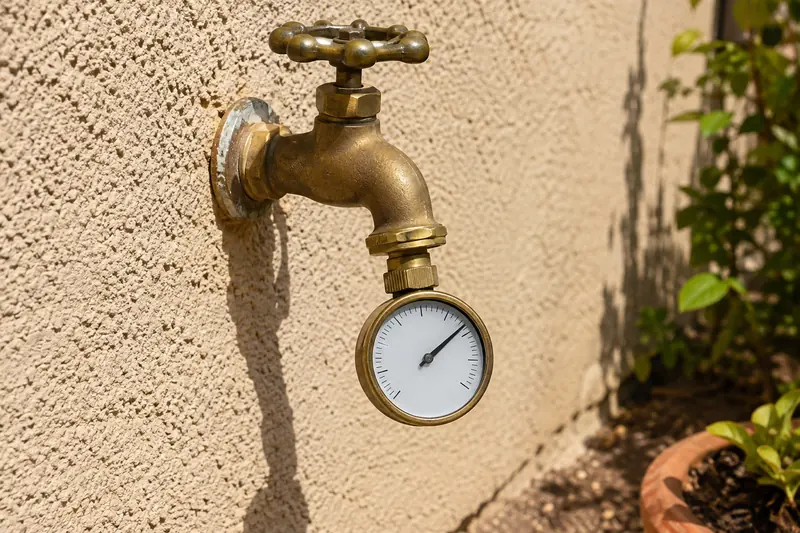
To check water pressure, thread a gauge onto a hose bib, turn off every tap and water-using appliance, open the bib and read the needle; Rainbow Water looks for 30 to 80 psi.
- 3.2Pressure Reducing Valves6 min
A pressure reducing valve is a spring-loaded regulator on your side of the meter that brings street pressure down to a steady level, and code requires one wherever static pressure tops 80 psi.
- 3.3Thermal Expansion Tanks6 min
An expansion tank gives heated water room to grow; once a regulator, check valve or backflow preventer stops water flowing back to the main, the plumbing code requires one.
- 3.4High Pressure on Hillside Lots6 min
High water pressure on hillside lots comes from elevation: the lower a home sits below the district's tanks, the more pressure arrives, which is why many North County parcels need two regulators.
Chapter overview
Why is pressure high on the hills?
Because water in a gravity system gains pressure as it flows downhill, and inland North County is mostly hills. Rainbow Municipal Water District states that pressure at a given spot "is largely a function of terrain and elevation," and that reservoir levels and demand move it too. A house low on a slope below a tank can see far more pressure than a neighbor near the top.
Districts manage this with stations in the street. Rainbow runs 80 of them, and the City of Escondido's water division lists 50 pressure reducing and regulating stations. Rainbow says its stations help cut leaks in the main pipelines, and that a district regulator in front of a meter protects the meter, not the house piping. The full picture for sloped lots is on high pressure on hillside lots §3.4.
| Figure | What it is | Source |
|---|---|---|
| 80 | Pressure-reducing stations Rainbow Water operates in its mains | Rainbow MWD regulator FAQ |
| 50 | Reducing and regulating stations in Escondido's water system | Escondido water division overview |
| 80 psi | Static reading where state code requires a house regulator | 2025 California Plumbing Code §608.2 |
| 10-15 years | Usual working life Rainbow gives a home regulator | Rainbow MWD regulator FAQ |
| 30-80 psi | Band Rainbow treats as normal at a hose bib | CPC 2025 section 608.2; Rainbow MWD pressure regulator FAQ; Vallecitos WD |
| About 50 psi | Where Rainbow and Vallecitos say owners usually land | CPC 2025 section 608.2; Rainbow MWD pressure regulator FAQ; Vallecitos WD |
| 80 stations | Pressure-reducing stations in Rainbow's district system | CPC 2025 section 608.2; Rainbow MWD pressure regulator FAQ; Vallecitos WD |
What pressure should a house have?
Somewhere between 30 and 80 psi, by Rainbow's guidance, with 80 as the hard ceiling set by code. Rainbow adds that owners typically set a home regulator around 50 psi, and Vallecitos Water District says most of its homeowners choose about 50 psi as well.
The code also sets a floor: §608.1 asks for at least 15 psi of residual pressure. You can learn your own number in a few minutes with a hose-bib gauge. The steps are on how to check your water pressure §3.1.
| Reading or setting | What it means | Source |
|---|---|---|
| Over 80 psi static | Code calls for a regulator with a strainer | CPC 2025, section 608.2 |
| 30 to 80 psi | Normal household range on a hose-bib test | Rainbow's district FAQ |
| About 50 psi | Where many owners set a home regulator | Rainbow Water; Vallecitos Water District |
| 15 psi | Lowest flowing pressure the code accepts | CPC 2025, section 608.1 |
What does a regulator do?
A pressure reducing valve, or PRV, is a spring-loaded valve that lowers the pressure coming from the main to a steady level for the house. Rainbow describes it as the main tool an owner has to control pressure, installed as close as possible to the house side of the meter.
Ownership surprises people. Rainbow says some meters have a district regulator in front of them, but that one exists to protect the meter, not your pipelines. The one that guards your plumbing belongs to you, and changing it is trade work. If you're unsure, call a licensed plumber. More on life span, ownership and replacement is on pressure reducing valves §3.2.
Why does a regulator need an expansion tank?
Because a regulator stops water from flowing back to the main, so water that swells as the heater warms it has nowhere to go. The code treats a home with a regulator, check valve or backflow preventer as a closed system, and §608.3 asks for a tank or similar device to absorb that growth.
The A. O. Smith gas water heater manual says a properly sized expansion tank belongs on all closed systems, and that the heater's relief valve is not meant for constant relief. How the tank works and what a dripping relief valve can mean are on thermal expansion tanks §3.3.
Common questions
- Does my water district promise a set pressure at my house?
No district statement found sets a delivered pressure for each address. Rainbow says pressure moves with elevation, reservoir levels and demand, and it leaves control at the house to the owner's regulator.
- Is a pressure regulator required on every North County home?
The code requires one wherever static pressure is over 80 psi. Rainbow goes further and says every home in its area should already have a second regulator, usually in the garage or where the line enters the house.
- Why did my pressure change after the district worked on my street?
Rainbow is building larger stations to lower pressure in its mains and removing some meter-side regulators where they are no longer needed. It still warns that reduced main pressure can stay above 80 psi, so a house regulator remains necessary.
- Who do I ask about pressure in my area?
Start with your water district: FPUD, Rainbow Water, VID, the City of Escondido or VCMWD. For anything beyond reading a gauge, a licensed plumber is the right call.
- What household signs point to a failing pressure regulator?
Rainbow Water's list starts with pressure that falls or jumps around, or none at all. It also names banging pipes, dripping fixtures and a toilet that never stops refilling. A hose-bib gauge reading confirms the problem. Replacing or resetting the valve is a job for a licensed plumber.
- How long does a home pressure regulator usually last?
Rainbow Water puts typical regulator life at 10 to 15 years. A house that has never had its regulator checked, or one past that age, is worth a gauge test. If the reading tops 80 psi, the 2025 California Plumbing Code §608.2 calls for a working regulator.
Sources
Sources for this hub: the pressure sections (608.1 to 608.3) of the 2025 California Plumbing Code on IAPMO's site, two Rainbow Water pages on regulators and system pressure, the Vallecitos regulator page, Escondido's water division overview and A. O. Smith's gas heater manual, each read October 2026. No contractor blogs or price quotes went into it, and no gauge readings of our own.
Checked October 29, 2026. Inline links in the text above go to each source.