§5.1 Chapter 5 · Irrigation and backflow
Backflow Testing
Summary. Backflow testing is a yearly field check of the device at your meter by a certified tester, and in North County your district decides whether it sends the tester or you hire one.
Section 5.1 · revised · checked against district reports, code and agency pages · about 8 min to read
Supplier note: this section links to PlumbingSupplyAndMore, owned by the people who run North County Water & Pipes. Those links are labeled examples; no figure here depends on them. About these links
5.1.1 Why do backflow devices exist?
A backflow device keeps water that has been on your property from running back into the public main. That can happen when pressure in the street drops, which pulls water backward, or when pressure on your side pushes harder than the main. Rainbow Water lists the hazards it has in mind: well water of unknown quality, chemicals from a fertilizer injection system and stagnant water sitting in fire sprinkler lines.
Inland North County has plenty of all three. Many parcels were groves or still are, plenty of rural homes have a private well, and newer houses in fire country often have sprinklers. Rainbow also notes that the devices matter during the low-pressure events a wildfire can cause, when firefighting draws heavily on the system.
| Figure | What it is | Source |
|---|---|---|
| 1 year | Longest gap allowed between field tests of an assembly | State Water Board CCCPH |
| 1,200+ | Devices FPUD owns, tests and maintains in its area | FPUD backflow program |
| 30 days | Time VCMWD allows to install a device after notice | VCMWD backflow devices page |
| 12 inches | Clearance a PVB needs above all downstream piping | State Water Board CCCPH |
| April 21, 2026 | Revised state handbook took effect | State Water Board resolution 2026-0013 and handbook; FPUD backflow program; VCMWD backflow devices page |
5.1.2 Which properties need one?
Agricultural use, a well or other second supply, and a fire sprinkler system are the triggers most homeowners meet. The state handbook's list of premises that need protection includes "sites with an auxiliary water supply" and "agricultural premises", and it calls for at least a double check where a home has a fire protection system, though some low-hazard residential fire systems need no assembly at all.
The April 2026 revision, adopted by State Water Board resolution, drops the old split between wells that are tied into the house plumbing and wells that are not. In practice, a property with a well and district water should expect a device at the meter in every district covered here. Well owners can read more on testing a private well §7.3.
| District | Who needs a device | Who runs the annual test | Who pays for repairs |
|---|---|---|---|
| Fallbrook PUD | Farm and former farm parcels, wells, recycled water | FPUD, for a monthly fee | FPUD maintains it once it takes ownership |
| Rainbow Water | Hazards named: wells, fertilizer injectors, fire lines | Rainbow, yearly | Owner hires a certified technician |
| Vista Irrigation District | Commercial, industrial, farm and multi-family accounts, plus wells | Not stated on VID's page; ask VID | Ask VID |
| Valley Center MWD | Every meter it installs; DC for wells, auxiliary supplies and fire systems; RP where fertilizer or chemicals may enter | VCMWD, yearly, billed to you | VCMWD repairs as needed and charges you |
| City of Escondido | Farm, multi-family and commercial sites, plus fire sprinklers, wells, booster pumps and auxiliary supplies | You hire a certified tester | You |
5.1.3 How often is a device tested?
At least once a year. The handbook also requires a field test right after an assembly is installed, repaired or moved, and it says all of that testing must be done by a certified backflow prevention assembly tester. Testers must hold certification from a body the State Water Board recognizes, and that bar rises after a three-year phase-in. The simplest route is to use the approved list your district keeps.
Escondido's own FAQ still cites the pre-2024 state rules as the reason for yearly testing. The rule changed hands in July 2024, but the annual schedule did not change.
5.1.4 Who arranges the test in your district?
It depends entirely on the district, so check your water bill to see which one serves you.
Fallbrook PUD. FPUD inspects every device in its area each year, "per state law", and says it alone inspects and maintains them. You do not book a tester. If a new device is required, you pay to have it installed to FPUD's specification, usually by a plumber; once it passes inspection, FPUD takes ownership. A parcel that is no longer farmed and has no second water source can file FPUD's Backflow Questionnaire and may be able to have the device removed and the monthly fee stopped.
Rainbow Water. Rainbow tests devices every year and bills a monthly fee. If a device fails, Rainbow sends a repair letter and the owner hires a certified technician to fix it. Rainbow publishes a list of testers whose certification the County Department of Environmental Health has verified.
Valley Center MWD. VCMWD puts a District-approved device on each meter it installs. Homes with fire sprinklers often have two meters, a brass one for domestic water and a red one for the fire system. If VCMWD notifies you that a device is required and it is not installed within 30 days, service may be interrupted. The District inspects all devices yearly, repairs them as needed and charges the customer.
City of Escondido. The owner arranges the test. A certified tester checks the assembly by the due date and submits results electronically through the city's online system. When Escondido orders a new device, it must be a reduced pressure (RP) assembly installed directly behind the meter.
Vista Irrigation District. VID's backflow page confirms which accounts need a device but does not describe who books the yearly test. Call or write to VID through its website before you hire anyone.
5.1.5 What are RP, DC and PVB devices?
They are the three assembly types most homes in the area have, and they differ in how much hazard they can guard against.
Assembly types in the state handbook
- RP (reduced pressure principle)
Two check valves that work independently plus a relief valve between them that opens to dump water if pressure goes wrong. This is the high-hazard choice; Escondido requires it for new devices, and VCMWD wants it wherever fertilizer or chemicals can get in.
- DC (double check)
Two check valves with no relief valve. The handbook allows it only for low-hazard connections. FPUD is phasing its DC devices out, and the 2026 revision sets criteria for keeping existing ones in service.
- PVB (pressure vacuum breaker)
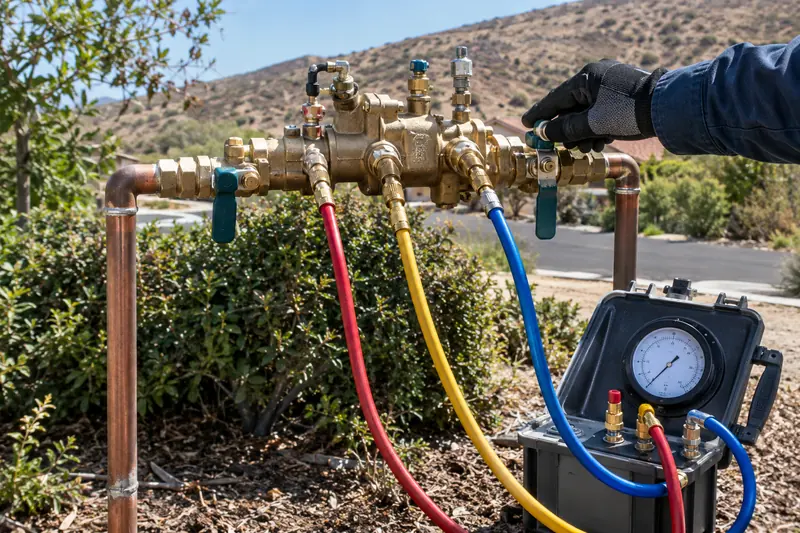
Guards against backsiphonage only, not backpressure, and has to sit at least 12 inches above all downstream piping and outlets. You often see one on an irrigation line.
A hose-bib vacuum breaker is something else again. The EPA cross-connection manual describes it as a small add-on that screws onto an outdoor faucet feeding a garden hose; it is not the assembly your district tests at the meter.
Testing a backflow assembly is work for a certified tester, and your district decides who books one and who repairs a failed device; if the rules for your property are unclear, ask your district or a certified backflow tester. If you see water leaking from the assembly, tell your district rather than taking it apart. Fitting a new device to the district's specification is plumbing work. If you're unsure, call a licensed plumber. Our page on choosing a plumber §4.5 covers license checks.
5.1.6 Common questions
- Can a homeowner test their own backflow assembly?
No. The state handbook requires every required field test to be done by a certified tester. In the FPUD and VCMWD areas the district does the test itself, so there is nothing to book.
- What happens after a failed test in Rainbow Water's area?
Rainbow mails a repair letter. The owner then hires a certified technician to repair the device, and the repaired assembly has to be tested again, as the handbook requires after any repair.
- Can FPUD take out a device on a parcel that stopped farming?
Possibly. If the property is no longer agricultural and has no well or other second supply, FPUD's Backflow Questionnaire is the way to ask for removal, which also ends the monthly maintenance fee.
- Why does a Valley Center house have a red meter as well as a brass one?
VCMWD says homes with fire sprinklers often have two meters. The brass one serves domestic water and the red one feeds the fire system.
- Does an unused well still count?
Assume it does until your district says otherwise. The 2026 revision removed the distinction between connected and unconnected auxiliary supplies such as wells, and every district here lists wells as a reason for a device.
- Why do some Escondido notices quote older state rules?
The city's FAQ still names the regulations that applied before July 1, 2024. The State Water Board handbook replaced them on that date, and the yearly test requirement carried over unchanged.
- How long does Valley Center give you to fit a required device?
Thirty days from proper notice. After that, VCMWD says service may be interrupted.
5.1.7 Sources for this section
Read in October 2026: the Cross-Connection Control Policy Handbook from the State Water Board (2023 adopted text, plus the 2026 revision resolution); backflow program pages from the City of Escondido, Valley Center MWD, Rainbow Water, FPUD and VID; and EPA's 2003 cross-connection control manual. Tester fees, device prices and contractor blogs were deliberately left out, and no device was checked by us.
Checked October 29, 2026. Inline links in the text above go to each source.