Chapter 2 of 7
Hard Water in North County
Summary. Hard water in North County San Diego is the rule, not the exception: every district's main 2025 supply tested above 180 mg/L, the USGS line for "very hard."
Chapter 2 · revised · checked against district reports, code and agency pages
Supplier note: this section links to PlumbingSupplyAndMore, owned by the people who run North County Water & Pipes. Those links are labeled examples; no figure here depends on them. About these links
Sections in this chapter
- 2.1Water Hardness by District6 min
Water hardness across inland North County ran from about 215 to 235 mg/L in 2025 for most taps, or roughly 12.6 to 13.7 grains per gallon.
- 2.2Who Supplies Your Water6 min
Who supplies your water depends on your address: five districts serve inland North County, and two of them, Fallbrook PUD and Rainbow, switched wholesalers in 2024.
- 2.3Water Softeners in North County6 min
Water softeners make sense in North County mainly for scale, since most taps run 13 to 14 grains, but they add sodium, can't feed plants and can't drain to septic.
- 2.4Chloramine and Home Filters6 min
Chloramine is the disinfectant in every inland North County district's water; carbon can break it down, but more slowly than chlorine, so filter size and contact time matter.
Chapter overview
How hard is North County water?
Very hard, in every district's own 2025 numbers. The U.S. Geological Survey sorts water into four classes: 0-60 mg/L soft, 61-120 moderately hard, 121-180 hard, and over 180 very hard. Fallbrook, Rainbow, Escondido and the Skinner supply that feeds Valley Center all sit between 215 and 235 mg/L on average.
The one soft exception is desalinated seawater from Carlsbad, which Valley Center MWD's 2025 report measured at 60.5 mg/L. Homes that get a lot of that blend will read lower. The full district table, with ranges and grain conversions, is on water hardness by district §2.1.
| District | Hardness, mg/L | Grains per gallon |
|---|---|---|
| Fallbrook PUD | 235 (range 200-270) | 13.7 |
| Rainbow Water | 230 (range 228-232) | 13.45 |
| City of Escondido | 215 (range 210-230) | roughly 12.6, converted by us |
| Vista Irrigation District | 54-310 by source | 3.2-18.1 |
| Valley Center MWD | 230 for Skinner water, 60.5 for Carlsbad desal (reported by source only) | roughly 13.5 and 3.5, converted by us |
| Figure | What it is | Source |
|---|---|---|
| 235 mg/L | Fallbrook PUD system average, equal to 13.7 grains | FPUD 2026 water quality report |
| 230 mg/L | Rainbow Water yearly average, equal to 13.45 grains | Rainbow 2025 water quality report |
| 215 mg/L | City of Escondido treated-water average | Escondido 2025 water quality report |
| 180 mg/L | Point past which USGS calls water very hard | U.S. Geological Survey |
Where does your water come from?
Mostly from far away, through Metropolitan's Lake Skinner plant or local reservoirs. Fallbrook PUD and Rainbow quit the regional Water Authority for Eastern Municipal Water District: FPUD on January 1, 2024, and Rainbow when its detachment became final on November 1, 2024, per Rainbow Water. Fallbrook also treats local Santa Margarita River water, which FPUD says now covers roughly half its supply.
Vista, Escondido and Valley Center still buy imported water through the Water Authority. Escondido and Vista also draw on Lake Henshaw. Source changes are the main reason hardness moves around; the background and the "who handles what" list are on who supplies your water §2.2.
Do you need a softener?
Not for health; NDSU Extension is plain that removing hardness is a comfort and equipment choice. People soften for scale, soap and appliances. Water heater makers lean toward treatment: where water is hard, A. O. Smith's manual recommends water softening or threshold-type treatment, and Rheem says scale builds unless water is 0-5 grains.
The trade-offs are local. Run NDSU's 8 mg/L per grain against Fallbrook's 13.7 grains and the softened water gains roughly 110 mg/L of sodium; that multiplication is ours. Softened water should not go on lawns, gardens or groves. And on a septic system, San Diego County's 2025 rules list softener backwash as a prohibited discharge. Sizing and those limits are covered on water softeners §2.3. For scale already inside a tank, see scale and flushing §6.1.
What about chloramine?
Every district here uses it. FPUD, VID, Escondido and Valley Center report chloramine (chlorine plus ammonia), and Rainbow says parts of its system switch to free chlorine at times. EPA says chloraminated water that meets its standards is safe for drinking, cooking and bathing.
Extension publications describe catalytic carbon as the filter medium designed for chloramine, with slower removal than plain chlorine. A softener does nothing to it. Filters, contact time and reverse osmosis are covered on chloramine and filters §2.4.
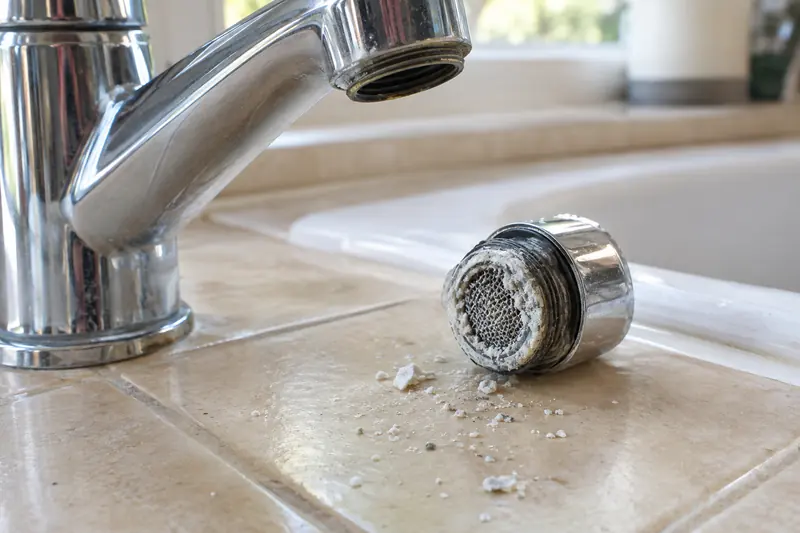
The quickest sign of hard water is often the faucet aerator. Unscrew it and look at the screen; white crust there is the same scale that settles in a water heater. Replacement screens and aerators sit in the faucet parts and accessories (PlumbingSupplyAndMore, owned by the people who run North County Water & Pipes) aisle.
Common questions
- Is North County tap water safe to drink even though it is hard?
Hardness is a measure of calcium and magnesium, not a safety rating. Each district's water quality report lists the regulated contaminants and whether they met standards; hardness shows up there as a mineral level only.
- Why does my aerator clog faster than in my last house?
Water above 200 mg/L carries more dissolved minerals to leave behind when it sits or dries. Soaking and rinsing it is a normal homeowner task.
- How do I convert mg/L of hardness into grains per gallon?
Divide by 17.1, the conversion FPUD and Rainbow print in their reports. FPUD's 235 mg/L average works out to 13.7 grains per gallon.
- Is Valley Center water harder than Fallbrook's?
It depends on the blend. Valley Center MWD gives hardness by source only, with no single average: Skinner water at 230 mg/L and Carlsbad desal at 60.5 mg/L, near 13.5 and 3.5 grains in our conversion, so a home's hardness follows the mix it receives.
- Which North County water is the softest?
Carlsbad desalinated seawater. Valley Center MWD measured its desal supply at 60.5 mg/L in 2025, and Vista Irrigation District's desal source averaged 61 mg/L, right at the USGS line between soft and moderately hard. Homes that get mostly Skinner or Lake Henshaw water sit above 200 mg/L instead.
- Does hard water raise the cost of heating water?
It can. The USGS says scale from heated hard water can raise heating costs and lower the efficiency of electric water heaters. Rheem's manual adds that scale builds in a tank unless the supply is 0-5 grains, far below the 13.7 grains FPUD reports.
Sources
Numbers in this section come from five district reports on 2025 water (FPUD, Rainbow, VID, Escondido, VCMWD), plus USGS, EPA, NDSU Extension, A. O. Smith and Rheem manuals, and San Diego County's 2025 septic rules, all read October 2026. Grain figures marked "our conversion" use the 17.1 mg/L per grain that FPUD and Rainbow print. We did no water testing of our own and quote no prices.
Checked October 29, 2026. Inline links in the text above go to each source.