§2.4 Chapter 2 · Hard water
Chloramine and Home Filters
Summary. Chloramine is the disinfectant in every inland North County district's water; carbon can break it down, but more slowly than chlorine, so filter size and contact time matter.
Section 2.4 · revised · checked against district reports, code and agency pages · about 6 min to read
Supplier note: this section links to Quality Water Treatment, owned by the people who run North County Water & Pipes. Those links are labeled examples; no figure here depends on them. About these links
2.4.1 Why do North County districts use chloramine?
To keep a disinfectant in the water all the way to the farthest tap. FPUD's 2026 report says both Metropolitan and Fallbrook use chloramines "to carry a residual to our customers." EPA adds that some systems moved to chloramine to meet disinfection byproduct requirements.
North County's long pipelines and hillside tanks make that residual important. Escondido alone runs 423 miles of pipe, per the city's water division. VID's report and Valley Center's both list chloramine as the disinfectant leaving their plants.
| District | Disinfectant reported | Note |
|---|---|---|
| Fallbrook PUD | Chloramines | Same as Metropolitan's Skinner water |
| Rainbow Water | Chloramines, with some free chlorine | Parts of the system convert under operating conditions |
| Vista Irrigation District | Chloramines | Added at the treatment plants |
| City of Escondido | Chloramine | Combined chlorine and ammonia |
| Valley Center MWD | Chloramines | Reported as total chlorine residual |
2.4.2 Does chloramine affect taste or smell?
None of the five district reports read for this page describe a taste. EPA's position is about safety, not flavor: chloraminated water that meets its standards is safe to drink, cook with and bathe in. If you do notice a chlorine-like taste or smell, that is the problem carbon filters are built for.
The University of Georgia's extension bulletin says activated carbon treats "general taste and odor problems, including chlorine residue." If a smell appears only in Rainbow's service area at certain times, the district's note about free chlorine in parts of its system is a likely place to start asking.
2.4.3 Which filters reduce chloramine?
Activated carbon, ideally catalytic carbon, sized for enough contact time. NDSU Extension says residual disinfectants such as chlorine and chloramines are removed by catalytic reduction in carbon, and calls catalytic carbon "an advanced activated-carbon product designed to adsorb chloramines."
Contact time is the catch. UGA says chlorine breaks down within seconds in the first few inches of a new carbon bed, but chloramine conversion is "a relatively slower reaction." A deeper bed means more carbon, longer contact and longer life, UGA notes. That fits NDSU's warning that pour-through and faucet-mounted units do not give the contact time needed for significant removal of contaminants.
| Figure | What it is | Source |
|---|---|---|
| 1 in 5 | More than this share of Americans use chloraminated water | EPA, Chloramines in Drinking Water |
| 1930s | Decade since which water utilities have used chloramines | EPA, Chloramines in Drinking Water |
| 6 months | Service interval UGA says is frequently advised for carbon cartridges | University of Georgia Extension B1542 |
| Seconds | Time for chlorine to break down in a new carbon bed, per UGA | University of Georgia Extension B1542; NDSU Extension filtration publication |
| 5 days | Idle time after which NDSU warns a carbon bed can grow bacteria | University of Georgia Extension B1542; NDSU Extension filtration publication |
| 0 grains | Hardness that carbon removes, per NDSU and UGA | University of Georgia Extension B1542; NDSU Extension filtration publication |
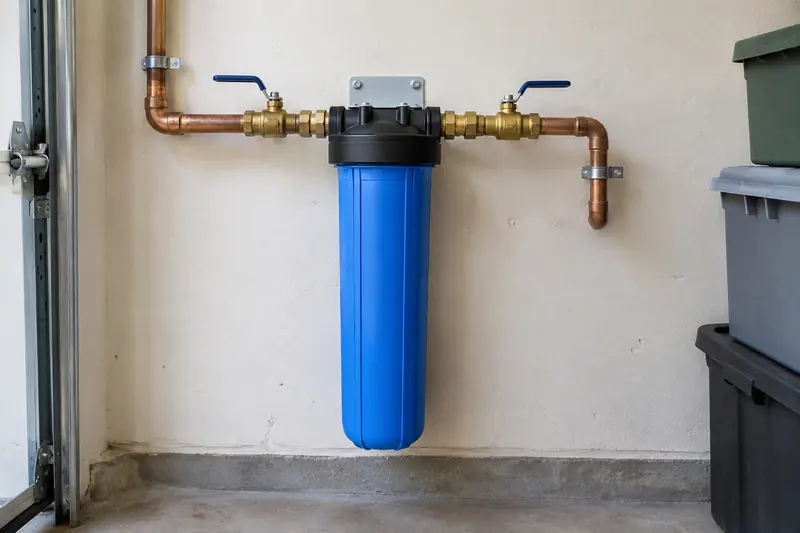
For a whole-house unit, ask three things before buying: what type of carbon it holds, the flow rate its rating assumes, and how many gallons it treats before replacement. UGA lists the same questions: carbon type, flow rate, contact time and the contaminant load the unit can handle. A unit like this whole-house carbon filter (Quality Water Treatment, owned by the people who run North County Water & Pipes) should be judged on those answers. No standard number for chloramine reduction is quoted here, because no district or federal page read for this site names one.
Carbon has limits worth knowing. UGA says it does not remove bacteria, nitrate, fluoride, chloride or hardness, and NDSU adds sodium to that list. Both warn that a loaded or idle carbon bed can grow bacteria: NDSU flags filters unused for more than 5 days, and UGA advises running water through for a few minutes after several days without use.
2.4.4 Should a filter go before a softener?
No source read for this page sets an order, so follow the softener maker's installation manual. What the sources do establish helps frame the choice. Carbon removes the disinfectant but not hardness; a softener removes hardness but not chloramine. Water leaving the carbon has had its disinfectant reduced, UGA recommends carbon filters only on microbiologically safe water, and both extension services say idle beds need flushing.
Either way, both units serve the house. Outdoor faucets and grove lines can branch off ahead of them, which also keeps softened water away from plants, as covered on water softeners §2.3. Cutting into the main line to mount a housing goes beyond homeowner scope and is a job for a licensed plumber.
2.4.5 What about reverse osmosis?
Reverse osmosis is a drinking-water tool, not a whole-house one. Nebraska Extension says a home membrane typically makes 10 to 35 gallons a day, into a storage tank of 2 to 5 gallons, and sends part of the feed water to the drain to carry away what it rejects. In its example, a 20% recovery rate turns 100 gallons of feed into 20 gallons of treated water and 80 of waste.
RO systems already use carbon. Nebraska says a thin-film membrane fed chlorinated water needs a carbon prefilter to remove the chlorine, and that prefilters and postfilters need regular replacement. Nebraska lists sodium among what RO removes, which matters if a softener has added some. On septic, note Nebraska's warning that the reject water increases the load on the system. For hardness numbers by district, see water hardness by district §2.1.
2.4.6 Common questions
- Does boiling water remove chloramine?
None of the district reports or EPA's chloramines page give boiling advice for chloramine. Carbon is the method the extension sources describe.
- Does a pitcher filter remove chloramine?
NDSU says pour-through units lack the contact time for significant removal of contaminants, and UGA says chloramine breaks down more slowly in carbon than chlorine does. Check the maker's stated claims before relying on one.
- Why does Rainbow water sometimes smell more like chlorine?
Rainbow says parts of its system convert from chloramine to free chlorine under certain operating conditions. Ask the district when and where that happens.
- Can I use tap water in a fish tank?
The local reports read for this page give no aquarium guidance. Ask your district's water quality staff and the tank supplier before filling.
- How often should a whole-house carbon filter be changed?
Follow the maker's rating in gallons. UGA says cartridges must be replaced when taste or odor problems return, and a meter on the filter helps judge when.
- Does carbon remove fluoride or nitrate?
No. UGA lists fluoride and nitrate among what ordinary activated carbon does not remove, along with bacteria, chloride and hardness.
2.4.7 Sources for this section
What this page draws on: the five districts' reports on 2025 water, EPA's chloramines page, and extension publications from NDSU (filtration), the University of Georgia (activated carbon, B1542) and Nebraska (reverse osmosis, G1490), all read October 2026. No certification standard number for chloramine appears here, since none of those sources states one, and no filter was put through trials for this page.
Checked October 29, 2026. Inline links in the text above go to each source.