§2.3 Chapter 2 · Hard water
Water Softeners in North County
Summary. Water softeners make sense in North County mainly for scale, since most taps run 13 to 14 grains, but they add sodium, can't feed plants and can't drain to septic.
Section 2.3 · revised · checked against district reports, code and agency pages · about 6 min to read
Supplier note: this section links to SoftPro Water Systems, owned by the people who run North County Water & Pipes. Those links are labeled examples; no figure here depends on them. About these links
2.3.1 Do you need a softener with 13 to 14 grain water?
You don't need one for health, but most North County water is hard enough that scale is a real cost. NDSU says hardness removal "is not a necessity to protect your health"; people soften for bathing, cleaning and appliances. The case rests on equipment.
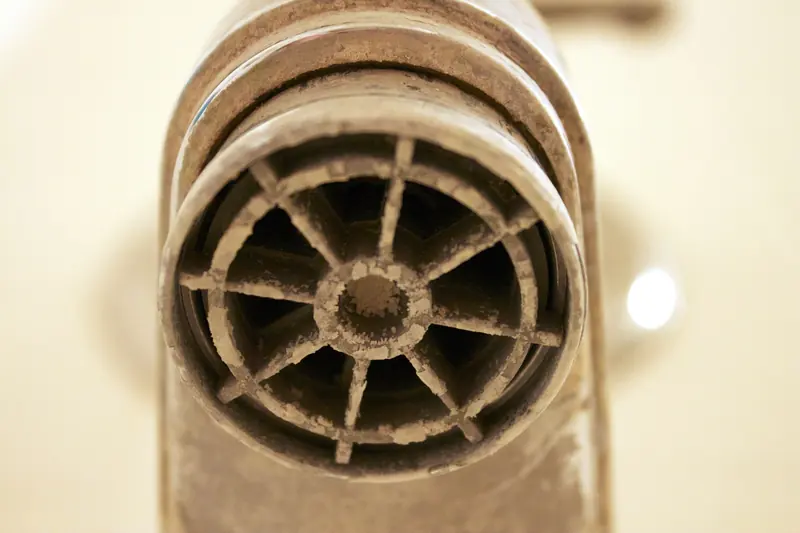
Both major water heater makers address it. A. O. Smith's gas manual recommends "water softening or the threshold type of water treatment" where water is hard. Rheem's manual says scale builds in the tank unless water is 0-5 grains, and faster at higher temperatures. At 12.6 grains in Escondido (our conversion) and 13.7 in Fallbrook, every district's main supply is well past that. If you don't soften, the alternative is the flushing routine in your heater's manual, covered on scale and flushing §6.1.
2.3.2 How is a softener sized?
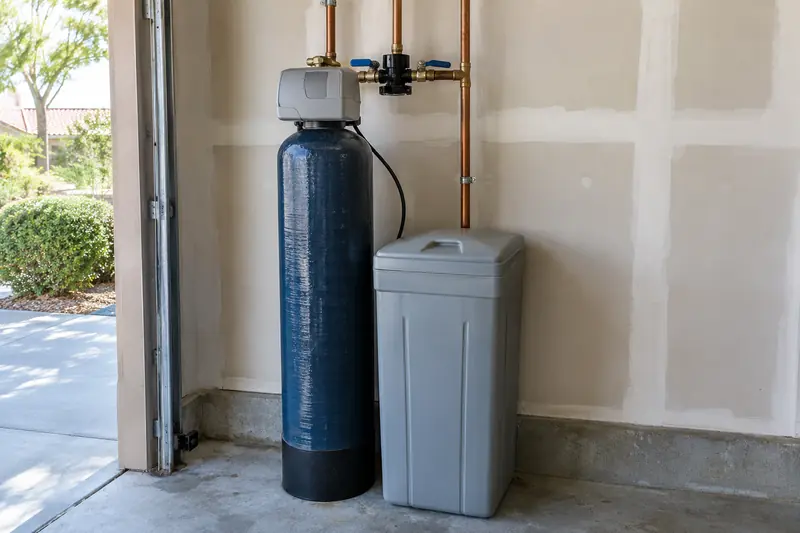
By how many grains of hardness it removes between recharges. NDSU says the time between regenerations depends on the water's hardness, how much water the home uses, the softener's rated hardness removal and the capacity of its resin. In North County, the first number is fixed by your district: roughly 13 to 14 grains for most taps.
The arithmetic is simple. Every 100 gallons of 13.7-grain water carries 1,370 grains of hardness. Multiply your household's daily gallons by your hardness to get the grains removed per day, then compare that with the softener's rated capacity to see how often it will recharge. Your bill shows use per billing period; divide by the days in the period. Test your tap first, because Vista and Valley Center blends vary widely. The SoftPro guide to testing hardness at home (SoftPro Water Systems, owned by the people who run North County Water & Pipes) walks through cheap test methods.
NDSU describes three control types: a timer that recharges on a schedule, demand-initiated regeneration that recharges by actual use, and off-site regeneration, where a rental tank is swapped for a recharged one. Recharging "too early wastes salt and water," NDSU notes, which favors demand control in a house whose use swings. Whatever unit you look at, such as the SoftPro Elite softener (SoftPro Water Systems, owned by the people who run North County Water & Pipes), check its control type and rated capacity against your own grains per day.
| District | Grains per gallon | Grains in every 100 gallons (our arithmetic) |
|---|---|---|
| Fallbrook PUD | 13.7 | 1,370 |
| Rainbow Water | 13.45 | 1,345 |
| City of Escondido | about 12.6 | about 1,260 |
| Vista Irrigation District | 3.2-18.1 | 320-1,810 |
2.3.3 How much sodium does softening add?
About 8 mg/L for each grain removed, per NDSU. Softening Fallbrook's 13.7-grain water would add roughly 110 mg/L of sodium, by our arithmetic, on top of the 85-88 mg/L FPUD's report already shows. Rainbow's 13.45 grains works out to about 108 mg/L added.
| Figure | What it is | Source |
|---|---|---|
| 8 mg/L | Sodium added per grain of hardness removed | NDSU Extension WQ1031 |
| 85 mg/L | Sodium already in Rainbow's 2025 water | Rainbow Water 2025 Water Quality Report |
| 88 mg/L | Sodium average in Escondido's 2025 water | City of Escondido 2025 Water Quality Report |
| 13.7 grains | FPUD's 2025 average hardness per gallon | FPUD 2026 report; NDSU Extension WQ1031; San Diego County 2025 LAMP |
| 110 mg/L | Sodium added softening 13.7-grain water, our arithmetic | FPUD 2026 report; NDSU Extension WQ1031; San Diego County 2025 LAMP |
| §2.3.8 | County septic rule listing softener backwash as prohibited | FPUD 2026 report; NDSU Extension WQ1031; San Diego County 2025 LAMP |
NDSU says people on restricted-sodium diets "should account for" the added sodium, and that potassium chloride can replace sodium chloride when health or environmental reasons call for it. It costs more and takes about 10% more salt per recharge. Leaving one cold drinking tap unsoftened is a plumbing choice to make at install.
Sodium is also why softened water stays off the garden. NDSU does not recommend it for houseplants, lawns or gardens. UC ANR calls avocado "the most sensitive tree crop to salts in water," so on a grove parcel the irrigation line should branch off ahead of the softener. Grove watering is covered on avocado and citrus trees §5.3.
2.3.4 Can a softener drain into a septic system?
No. San Diego County's Local Agency Management Program, effective February 1, 2025, lists "Backwash from water softeners" among prohibited discharges in §2.3.8, and owners must keep those discharges out of the system. NDSU makes a related point: recharge water can overload or reduce the effectiveness of small septic systems.
That matters across Fallbrook, Bonsall, Rainbow and Valley Center, where many rural parcels are on septic. Softener backwash may not go into a septic system; ask the County Department of Environmental Health and Quality (DEHQ) before installing one on a septic property. NDSU also describes off-site regeneration, usually rental units, where a used tank is swapped for a recharged one. The sewer side is separate: Water Code 13148 lets local agencies restrict salt-discharging softeners only after a regional board finding, and no such North County rule was found. A 1994 decision invalidated Escondido's 1991 ban, per a Metropolitan counsel letter.
2.3.5 What about salt-free conditioners?
They are a different category, and the primary sources say little about them. Where water is hard, A. O. Smith recommends threshold-type treatment as well as water softening, which supports the idea of treating scale without exchanging minerals. No district, state agency or extension source we read rates how well salt-free devices work on 13-grain water.
Two practical points follow. A device that does not remove calcium and magnesium will not change a hardness test, so ask its maker what measurement shows it working. And it adds no sodium and sends no brine down the drain, which is the reason septic owners look at them. Installation is plumbing work on the main line, done by a licensed plumber.
2.3.6 Common questions
- Should the hose bibs be on softened water?
Usually not. NDSU does not recommend softened water for lawns, gardens or houseplants, so it makes sense to plumb outdoor faucets and irrigation lines ahead of the softener.
- Can I use potassium chloride instead of salt?
Yes, NDSU lists it as an option when sodium is a concern. It is more expensive, holds to the resin more strongly and uses about 10% more salt per recharge.
- Will a softener remove chloramine?
No. A softener exchanges hardness minerals for sodium; chloramine reduction is a job for carbon media, covered on the chloramine and filters page.
- Does Escondido still ban softeners?
No. The city's 1991 ban on self-regenerating softeners was struck down in 1994, and no current North County restriction was found.
- How often will a softener regenerate on 13.7-grain water?
It depends on daily use and the unit's rated capacity. Divide the capacity in grains by your daily grains (gallons times 13.7) to estimate days between recharges.
- Is softened water a problem on a septic system in Valley Center?
Under San Diego County's LAMP, softener backwash may not enter a septic system at all, and Valley Center's rural parcels fall under those County rules.
2.3.7 Sources for this section
Read for this page: NDSU Extension's water softening publication (WQ1031), the A. O. Smith and Rheem water heater manuals, San Diego County's 2025 LAMP, California Water Code 13148, a 1994 Metropolitan counsel letter, UC ANR's avocado salinity material and the calendar-2025 reports from Fallbrook, Rainbow and Escondido, all in October 2026. Sodium and grain totals marked as our arithmetic are calculated, not quoted. Product prices and maker efficiency claims stay out, and nothing was bench-tested.
Checked October 29, 2026. Inline links in the text above go to each source.