§6.1 Chapter 6 · Water heaters
Scale and Flushing a Water Heater
Summary. A water heater flush clears the sediment that North County's very hard water leaves in a tank, and the safe way to do it is the method and interval printed in your heater's own manual.
Section 6.1 · revised · checked against district reports, code and agency pages · about 6 min to read
Supplier note: this section links to PlumbingSupplyAndMore and SoftPro Water Systems, owned by the people who run North County Water & Pipes. Those links are labeled examples; no figure here depends on them. About these links
6.1.1 What does hard water do inside a tank?
Hard water leaves mineral scale and loose sediment at the bottom of a tank as it is heated. In the USGS's words, that scale can cut the working life of equipment, make heating dearer and drag down electric heater efficiency (USGS). The DOE describes the same sediment as something that "impedes heat transfer" (DOE Energy Saver Guide).
Rheem's line is the clearest local yardstick: unless the supply is soft, 0 to 5 grains, deposits form, and they form faster when the thermostat is set higher (Rheem AP21831). Inland North County water runs more than twice that limit.
| Figure | What it is | Source |
|---|---|---|
| 235 mg/L | FPUD average, equal to 13.7 grains per gallon | FPUD consumer confidence report, 2026 |
| 230 mg/L | Rainbow Water mean, equal to 13.45 grains per gallon | Rainbow Water's report on 2025 |
| 215 mg/L | Escondido plant output, about 12.6 grains by the 17.1 conversion | Escondido's 2025 report |
| 3.2-18.1 gpg | Vista Irrigation District range, depending on source and flows | VID 2026 water quality report |
| 6 months | A. O. Smith's drain-and-flush interval | A. O. Smith 324257; Rheem AP21831; DOE Energy Saver Guide 2022; FPUD 2026 report |
| 1 month | Rheem's interval for draining a few quarts | A. O. Smith 324257; Rheem AP21831; DOE Energy Saver Guide 2022; FPUD 2026 report |
| 3 months | DOE's interval for draining a quart | A. O. Smith 324257; Rheem AP21831; DOE Energy Saver Guide 2022; FPUD 2026 report |
| 0-5 grains | Rheem's soft range, below which scale is not expected | A. O. Smith 324257; Rheem AP21831; DOE Energy Saver Guide 2022; FPUD 2026 report |
| 13.7 gpg | FPUD average hardness, 2025 data | A. O. Smith 324257; Rheem AP21831; DOE Energy Saver Guide 2022; FPUD 2026 report |
Not sure which district serves you, or how hard your own tap is? The North County hardness page §2.1 maps the numbers, and SoftPro explains a low-cost home hardness test (SoftPro Water Systems, owned by the people who run North County Water & Pipes).
6.1.2 What do maker manuals say about flushing?
The two manuals read for this page agree that sediment should come out, but they describe different jobs. A. O. Smith's residential gas manual recommends draining and flushing the storage tank every 6 months and gives step-by-step drain and flush procedures, with the flush done while system pressure is on (A. O. Smith 324257). Rheem's super-high-efficiency gas manual asks for something lighter and more frequent: drain a few quarts from the tank every month.
| Source | What it tells owners | Scope |
|---|---|---|
| A. O. Smith 324257 | Drain and flush the tank every 6 months | Residential gas models in that manual |
| Rheem AP21831 | Drain a few quarts every month | Rheem super-high-efficiency gas models |
| DOE Energy Saver Guide 2022 | Drain a quart every 3 months | General household advice, any brand |
The DOE's quart-every-3-months advice is general and names no model. A maker's manual is written for the valve, burner and tank in front of you, so it is the one to follow.
6.1.3 How often should you drain it?
Follow the interval in your heater's manual. No single number fits every tank, and the three sources above range from monthly to twice a year. Very hard water is a reason to keep to the more frequent end of whatever your manual allows, not a reason to invent a new schedule.
If the manual is missing, the model and serial plate on the tank identifies it, and makers post owner manuals online. Write the interval on a tag near the heater so it doesn't depend on memory.
6.1.4 What are the safety steps?
The safety steps are the ones in your manual, done in its order. A. O. Smith's version includes these cautions:
What the A. O. Smith manual warns about
- Hot water first
Open a hot tap and let it run until the water is no longer hot, so the drain doesn't release scalding water.
- Secure the hose
Make sure the drain hose is fastened before and during the whole flush, and keep hands clear of the drain valve.
- Gas waits for a full tank
Never turn the gas on before the tank is completely full of water.
The same manual also says that anyone not qualified and licensed or certified for a given task should not attempt it. A stuck or leaking drain valve, a pilot that won't stay lit, or anything touching the gas valve, burner or venting is a job for a licensed plumber. If you're unsure, call a licensed plumber. At any hint of gas smell, stop, walk out of the house without switching anything on or off, and once outside phone 911 or SDG&E's gas emergency line.
6.1.5 Does a softener help?
Softening attacks the cause. A. O. Smith's manual says that where hard water exists, "water softening or the threshold type of water treatment is recommended." Rheem's 0-5 grain line points the same way.
There are trade-offs. NDSU Extension says softening adds about 8 mg/L of sodium for every grain removed, and that softened water is not recommended for houseplants, lawns or gardens (NDSU). By our arithmetic, softening FPUD's 13.7-grain water would add about 110 mg/L of sodium on top of the roughly 85-88 mg/L already there. On septic, San Diego County's 2025 LAMP lists softener backwash as a prohibited discharge (§2.3.8). The water softeners page §2.3 covers sizing, bypass lines for groves and the septic question.
Drain valves and other spares are listed under water heater replacement parts (PlumbingSupplyAndMore, owned by the people who run North County Water & Pipes); fitting them is still work for a qualified person.
6.1.6 Common questions
- Why does water from the drain valve come out cloudy or gritty?
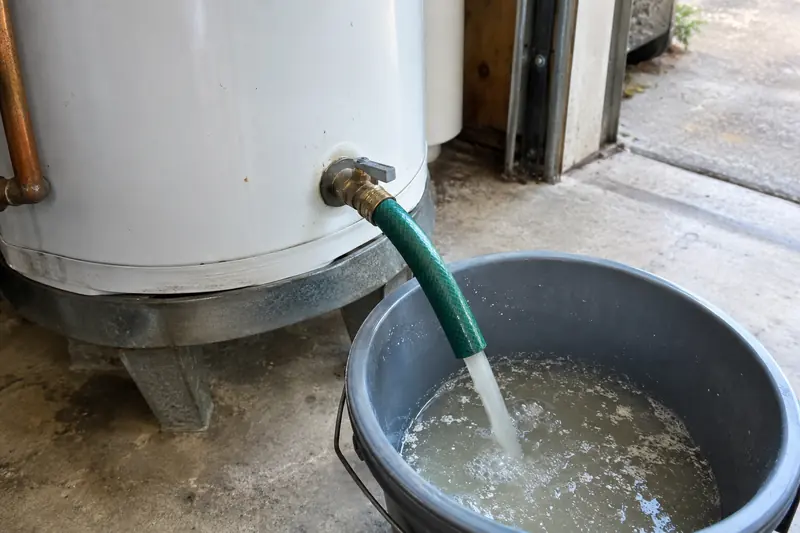
That is the sediment the flush is meant to remove: calcium settled out of heated hard water, as the USGS describes. Your manual says how long to run it; A. O. Smith's procedure flushes with system pressure on.
- Is draining a quart every 3 months enough in Rainbow?
It is the DOE's general advice, but Rainbow's 13.45-grain water is nearly triple the 5-grain ceiling in Rheem's manual. Use the interval in your own heater's manual, which may be monthly or every 6 months.
- Can sediment be cleared without a full drain?
Rheem's manual describes draining only a few quarts each month. A. O. Smith describes a fuller drain and flush. Which one fits depends on your model, so the manual decides.
- Does a higher thermostat setting make scale worse?
Rheem says scale accumulates faster at higher temperatures. Keeping the setting near 120°F, as DOE and SDG&E suggest, helps on both scale and scald risk.
- What should happen if the drain valve won't close fully after a flush?
Close the heater's cold inlet valve if it is within reach and call a licensed plumber. Valve and fitting replacement is beyond the owner steps the manuals list.
- Does Vista water need flushing as often as Fallbrook water?
Possibly not, since VID reported 3.2 to 18.1 grains depending on source and flows. The low end, 3.2 grains from water that is mostly desal, is under Rheem's 5-grain line, but most of that range is far above it, so follow the interval in your heater's manual.
- Will a whole-house filter stop tank scale?
For hard water, A. O. Smith recommends water softening or threshold-type treatment. Its manual says nothing about filters for scale. Filters and chloramine have their own page on filters §2.4.
6.1.7 Sources for this section
Sources here are the owner manuals A. O. Smith 324257 and Rheem AP21831, the DOE's 2022 Energy Saver Guide, USGS hardness classes, NDSU Extension's softening publication, San Diego County's 2025 LAMP and the 2025-data reports of FPUD, Rainbow, Escondido and VID, read October 2026. We left out contractor how-to videos, descaling products and any interval not printed by a maker or agency.
Checked October 29, 2026. Inline links in the text above go to each source.