§6.3 Chapter 6 · Water heaters
Earthquake Straps for Water Heaters
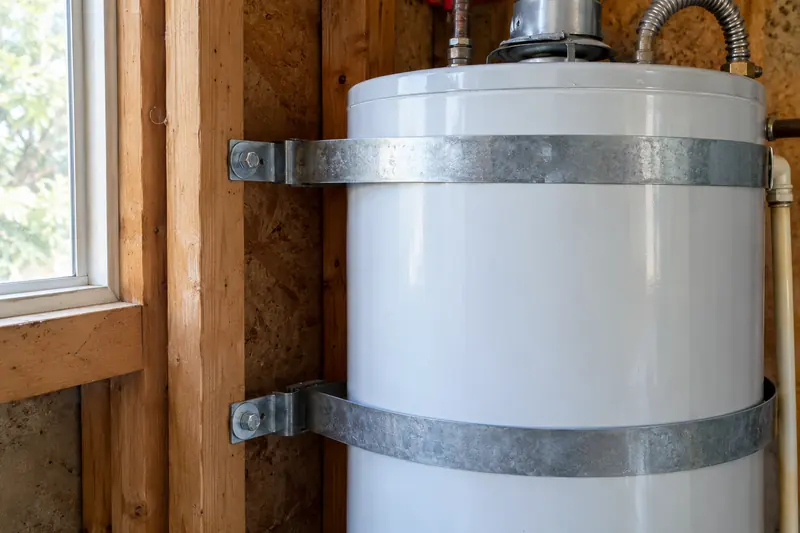
Summary. Water heater earthquake straps are required by California law on every residential tank, set in the upper third and lower third of its height with the lower strap at least 4 inches above the controls.
Section 6.3 · revised · checked against district reports, code and agency pages · about 6 min to read
6.3.1 What does California law require?
Every residential water heater in California has to be braced, anchored or strapped so it resists falling or sliding in an earthquake. That is Health & Safety Code 19211(a), and it applies to new, replacement and existing heaters alike (California Legislature). The section's coverage, in subsection (d), is heaters of 120 gallons or less, which takes in ordinary household tanks.
The rule reaches heaters already in place, not just new installs. California is earthquake country, and a tank full of hot water is heavy; a heater that tips can strain the water and gas connections attached to it.
| Rule | What it requires | Source |
|---|---|---|
| Health & Safety Code 19211(a) | Bracing, anchoring or strapping on new, replacement and existing residential heaters | California Legislature |
| Health & Safety Code 19211(b) | Seller certifies compliance | California Legislature |
| Health & Safety Code 19211(d) | Applies to heaters of 120 gallons or less | California Legislature |
| California Plumbing Code §507.2 (2025) | Strapping in the upper third and lower third; lower strap at least 4 inches above controls | IAPMO |
| SDG&E gas appliance safety | Restraints secured to wall studs | SDG&E |
| Figure | What it is | Source |
|---|---|---|
| 120 gallons | Upper size limit for heaters under Health & Safety Code 19211(d) | California Legislature |
| 4 inches | Clearance required between the lower strap and the controls | 2025 California Plumbing Code §507.2 |
| 18 inches | Minimum height of a garage gas heater's ignition source off the floor | SDG&E gas appliance safety |
| $1,000 | Contract size where CSLB requires a licensed installer | CSLB consumer page |
| Upper 1/3 | First strapping zone on the heater's height | Health & Safety Code 19211; CPC 2025 §507.2; SDG&E gas appliance safety |
| Lower 1/3 | Second strapping zone on the heater's height | Health & Safety Code 19211; CPC 2025 §507.2; SDG&E gas appliance safety |
6.3.2 Where do the straps go?
Straps go in the upper third and lower third of the heater's height, and the lower strap sits at least 4 inches above the controls. The 2025 California Plumbing Code §507.2, in force since January 1, 2026, words it as strapping "at points within" those two zones (IAPMO 2025 CPC). The code text does not set a count of straps; it sets the zones.
To check your own heater, measure its height and split it into thirds. There should be strapping in the top band and in the bottom band, and the lower strap should sit at least 4 inches above the gas control or thermostat, so it never presses on the valve or blocks access to it.
SDG&E adds where the other end goes: restraints belong on wall studs, as state law requires (SDG&E appliance safety).
6.3.3 What else applies to a garage heater?
Height. SDG&E says a gas water heater in a garage must be raised so the pilot flame or other ignition source is at least 18 inches above the floor. Flammable-vapor-resistant (FVIR) heaters may be exempt, and the label or manual on the heater says which kind you have. That rule is why garage heaters are often raised on a platform.
A platform adds a strapping detail: the straps still go in the upper and lower thirds of the heater, measured on the tank, and they still anchor to studs. The platform itself should be solid enough to carry a full tank.
Expansion control is a separate garage-corner item. Homes with a pressure regulator or a check valve need a thermal expansion tank under the plumbing code, often mounted near the heater; the expansion tanks page §3.3 covers it.
6.3.4 What happens when you sell a home?
A seller has to certify that the water heater meets the bracing requirement under Health & Safety Code 19211(b). In practice that means the straps should be checked well before listing, so a fix doesn't hold up the sale.
A quick pre-sale check: the heater is restrained in both the upper and lower thirds, the lower restraint is at least 4 inches above the controls, the fasteners go into studs, and a gas heater in a garage meets SDG&E's 18-inch rule or is an FVIR unit.
6.3.5 Who should install straps?
Have a licensed plumber fit or correct seismic straps, especially on a gas heater, where the work sits next to the gas connection, the burner and the venting. Strapping is also part of any replacement; the replacement and permits page §6.4 covers what an installer should include. If you're unsure, call a licensed plumber.
The CSLB draws the license line at a $1,000 contract, labor and materials counted together, and at any job that requires a permit (CSLB). Plumbing contractors hold the C-36 classification, and a license can be checked on cslb.ca.gov. More on vetting is on choosing a plumber §4.5.
After a strong quake, look at the heater from a distance first. A gas smell or hiss nearby means getting out of the house before touching anything; don't flip switches or use anything that could spark indoors, and phone 911 or SDG&E's gas emergency line from a safe spot outside (SDG&E gas leaks).
6.3.6 Common questions
- Does an old water heater that predates the strapping law need straps?
Yes. Health & Safety Code 19211(a) names existing residential water heaters along with new and replacement ones.
- How are the upper and lower thirds found on a tall tank?
Measure the heater's height and divide by three. The upper restraint goes in the top band and the lower one in the bottom band, placed at least 4 inches above the controls.
- Can straps be fastened into a stucco or block wall instead of studs?
SDG&E's wording is wall studs, as state law requires. A masonry wall needs anchors suited to it, which is a question for a licensed plumber.
- Does a new replacement heater need new straps?
Yes. Section 19211(a) names replacement heaters, so the new tank has to be braced, anchored or strapped when it goes in. Ask that strapping to the §507.2 zones be written into the quote.
- Does a garage heater on a platform still need straps?
Yes. The 18-inch ignition rule from SDG&E and the strapping rule are separate requirements, and a raised heater must meet both.
- What if the lower strap covers the gas control?
That placement breaks the 4-inch clearance in §507.2. A licensed plumber can move it up so it sits at least 4 inches above the controls while staying within the bottom third.
6.3.7 Sources for this section
This page rests on California Health & Safety Code 19211, the 2025 California Plumbing Code §507.2, SDG&E's gas appliance safety and gas-leak pages, and CSLB consumer guidance, read October 2026. We left out strap-kit product claims, installed prices and any strap count the code text does not state.
Checked October 29, 2026. Inline links in the text above go to each source.