§6.2 Chapter 6 · Water heaters
Temperature and the Relief Valve
Summary. Water heater temperature should start at about 120°F, the setting DOE, SDG&E and A. O. Smith all name, and the relief valve on top is a safety device that owners touch only as their manual allows.
Section 6.2 · revised · checked against district reports, code and agency pages · about 7 min to read
Supplier note: this section links to PlumbingSupplyAndMore, owned by the people who run North County Water & Pipes. Those links are labeled examples; no figure here depends on them. About these links
6.2.1 What temperature should a water heater be set to?
Start at about 120°F. The DOE's Energy Saver Guide gives 120°F as a setting considered safe for most of the population, and the federal FEMP checklist calls 120°F the "warm" setting (DOE FEMP checklist). SDG&E says 120°F or less, to reduce the risk of scalding and to save energy (SDG&E appliance safety).
The one exception SDG&E names is a dishwasher without its own booster heater, which may need 140°F. That is a household trade-off: hotter water at every tap means more scald risk at every tap.
On the heater itself, the A. O. Smith 324257 manual says the thermostat leaves the factory at its lowest setting and that the mark for roughly 120°F is the preferred starting point (A. O. Smith 324257). Turning the dial to that mark, following your own manual, is ordinary owner work. In hard-water country there is a second reason to stay low: Rheem says scale builds faster at higher temperatures, which the scale and flushing page §6.1 explains.
| Source | Recommended setting | Reason given |
|---|---|---|
| DOE Energy Saver Guide 2022 | 120°F | Considered safe for most people |
| DOE FEMP home checklist | 120°F, the "warm" setting | Energy savings |
| SDG&E gas appliance safety | 120°F or less; 140°F if a dishwasher lacks a booster | Scald risk and energy |
| A. O. Smith 324257 | About 120°F as a starting point | Ships at the lowest setting |
| Figure | What it is | Source |
|---|---|---|
| 120°F | Setting DOE considers safe for most of the population | DOE Energy Saver Guide 2022 |
| 140°F | What SDG&E allows for a dishwasher with no booster heater | SDG&E gas appliance safety |
| 2 times a year | Minimum T&P lever operation in the A. O. Smith manual | A. O. Smith 324257 manual |
| 80 psi | Static pressure above which a regulator and expansion tank follow | 2025 California Plumbing Code §608.2 |
6.2.2 What does the relief valve do?
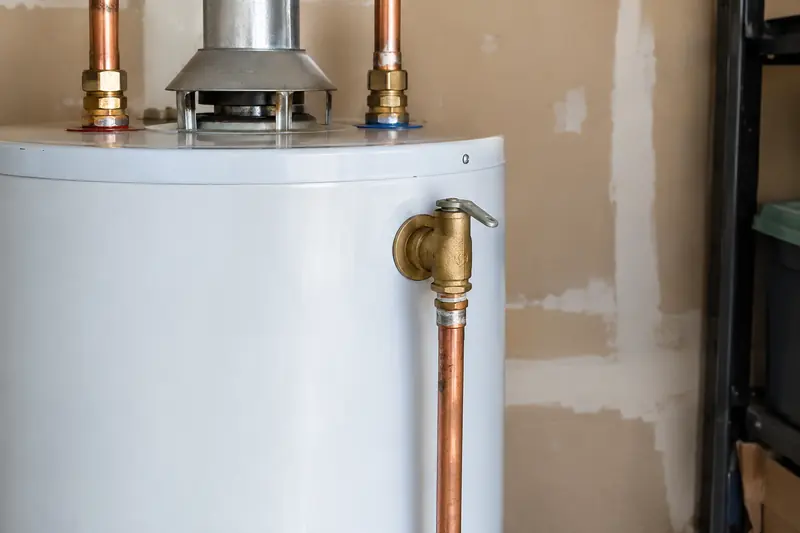
The temperature and pressure (T&P) relief valve is the heater's last line of defense: it opens to dump water if the tank gets too hot or the pressure climbs too high, and its discharge pipe carries that water away. A. O. Smith's manual is clear that the valve is not meant for constant relief; a heater that keeps relying on it has another problem to fix.
Never cap, plug or adjust a relief valve, and never block its discharge pipe. Rheem's manual says in capitals not to plug the outlet (Rheem AP21831).
6.2.3 What do manuals say about testing it?
The two makers read for this page split on who should touch the lever. The A. O. Smith manual tells owners to operate the valve manually at least twice a year by lifting the lever at its end several times, keeping people clear of where the hot water discharges. If the valve does not reseat and keeps running, A. O. Smith says it has to be replaced.
Rheem's manual takes the other route. It says periodic inspection of the relief valve and the venting system should be made by service technicians qualified in gas appliance repair, and it warns of scalding when the valve is operated. So the lever test is something the A. O. Smith manual tells its owners to do, with those scald cautions; on a Rheem heater, leave it to a qualified technician. On any other brand, go by that maker's manual.
Water from a T&P test comes straight from the tank, which is why both makers stress scalding. Keep hands, feet, children and pets well clear of the discharge pipe's outlet.
6.2.4 Why might the valve drip?
A valve that releases water now and then may be reacting to thermal expansion. Rheem's manual says occasional discharge may come from thermal expansion in a "closed" water system and tells owners to contact the water supplier or local plumbing inspector. A system is closed when a check valve, backflow preventer or pressure regulator stops expanding water from flowing back toward the main.
That describes a lot of North County. The 2025 California Plumbing Code §608.2 requires a regulator wherever static pressure exceeds 80 psi, plus an expansion tank downstream of it; §608.3 requires expansion control on any system with a check valve or backflow preventer (IAPMO 2025 CPC). Rainbow Water says many properties in its area need two regulators. A. O. Smith adds that a properly sized expansion tank must be installed on all closed systems. See thermal expansion tanks §3.3 and, to rule out high street pressure, checking your water pressure §3.1.
A steady drip, or a valve that won't reseat after a test, needs a licensed plumber rather than more lever work.
6.2.5 Which jobs are for a licensed pro?
Replacing a relief valve, installing an expansion tank, and anything touching the gas connection, venting or burner are licensed work. A. O. Smith's manual itself says that anyone not qualified, and licensed or certified where required, should not attempt a procedure. Replacement valves are sold under relief valves (PlumbingSupplyAndMore, owned by the people who run North County Water & Pipes), but choosing and fitting one is a job for a licensed plumber. If you're unsure, call a licensed plumber.
Gas comes first, ahead of any valve question. If there is a gas smell or a hissing sound near the heater, leave the building before doing anything else. Don't switch lights or appliances on or off and don't use anything that might spark indoors. From outside, call either SDG&E's gas emergency line or 911 (SDG&E gas leaks).
6.2.6 Common questions
- Is 120°F hot enough for a dishwasher?
It depends on the machine. SDG&E says a dishwasher without a booster heater may need 140°F; one with a booster heats its own water, so the tank can stay at 120°F or less.
- Where is the 120°F mark on an A. O. Smith gas control?
The A. O. Smith 324257 manual marks roughly 120°F with a symbol and calls it the preferred starting point. The manual for your exact model shows where that mark sits.
- What does it mean if the relief valve leaks right after a test?
A. O. Smith says that if the valve does not reseat, it must be replaced. Shut the cold-water supply to the heater if you can, keep clear of the hot discharge, and have a licensed plumber replace the valve.
- Should the relief valve on a Rheem heater be tested by the owner?
Rheem's AP21831 manual leaves periodic relief-valve inspection to technicians qualified in gas appliance repair and warns of scalding when it is operated. Follow that manual rather than another brand's advice.
- Can high street pressure make a relief valve open?
Pressure is half of what the valve watches. Rheem ties occasional discharge to thermal expansion in a closed system, and the plumbing code requires a regulator above 80 psi. A hose-bib gauge test is the first owner step; Rainbow Water gives 30-80 psi as the household range.
- Why does the discharge pipe run down to the floor?
The pipe carries scalding water down and away from anyone standing near the tank. Never cap or shorten it; changes to it are licensed work.
6.2.7 Sources for this section
This page leans on two owner manuals (A. O. Smith 324257, Rheem AP21831), the DOE Energy Saver Guide and FEMP checklist, SDG&E's appliance and gas-leak pages, the 2025 California Plumbing Code §608.2-608.3 and Rainbow Water's regulator FAQ, read October 2026. We left out contractor blogs, temperature-versus-time scald charts not found in a primary source, and any valve rating not printed by a maker.
Checked October 29, 2026. Inline links in the text above go to each source.