§3.3 Chapter 3 · Water pressure
Thermal Expansion Tanks
Summary. An expansion tank gives heated water room to grow; once a regulator, check valve or backflow preventer stops water flowing back to the main, the plumbing code requires one.
Section 3.3 · revised · checked against district reports, code and agency pages · about 6 min to read
Supplier note: this section links to PlumbingSupplyAndMore, owned by the people who run North County Water & Pipes. Those links are labeled examples; no figure here depends on them. About these links
3.3.1 What is thermal expansion?
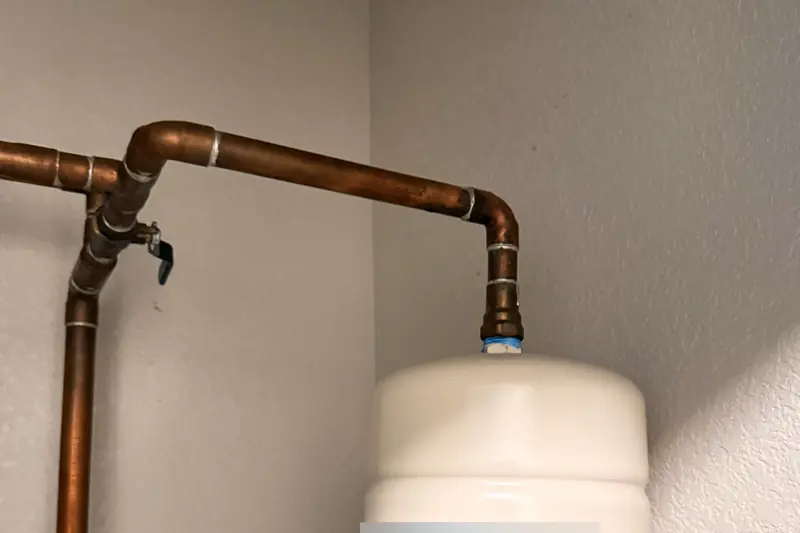
It is the growth in volume that happens when water warms up. Every time a tank water heater runs, the water inside takes up a little more room than it did cold, and that extra volume has to go somewhere.
In an open system it simply pushes back toward the water main. In a closed system it can't, so pressure inside the house climbs instead. That is why the code ties expansion control to devices that close the system, and why the A. O. Smith manual warns that the heater's relief valve was never meant to handle the job on a constant basis.
3.3.2 What makes a water system closed?
Any device that stops house pressure from bleeding back into the main. Section 608.3 names "a check valve, backflow preventer, or other normally closed device," and §608.2 separately calls for a tank after every pressure regulator. Many inland North County homes have at least one of these.
Backflow devices are common here because of groves, wells and rural parcels. FPUD requires one on agricultural and former agricultural properties and anywhere with a well or recycled water. Valley Center MWD puts a district-approved device on every meter it installs. The City of Escondido requires any new device it orders to be a reduced pressure assembly directly behind the meter, and VID requires one on agricultural accounts and properties with wells. Who tests them is covered on backflow testing in North County §5.1.
3.3.3 When does code require an expansion tank?
Whenever the house has a pressure regulator, and whenever a check valve, backflow preventer or similar closed device keeps pressure from returning to the main. Under §608.2 the tank belongs in the cold-water piping downstream of each regulator.
There is one alternative. On a system designed by a licensed plumbing contractor or a registered design professional, a relief valve set at 100 psi or less may be used in place of the tank. That is a design decision, not a homeowner swap.
| Situation on the property | Code section | What the code expects |
|---|---|---|
| Static pressure over 80 psi, regulator installed | 2025 CPC §608.2 | Expansion tank downstream of each regulator |
| Backflow preventer at the meter (well, grove, recycled water) | 2025 CPC §608.3 | Tank or similar expansion control |
| Check valve or other normally closed device | 2025 CPC §608.3 | Tank or similar expansion control |
| Designed system by a licensed contractor or design professional | 2025 CPC §608.2 | Relief valve set at 100 psi or less may replace the tank |
3.3.4 What are the signs of a problem?
The most telling one is a water heater relief valve that discharges now and then. The Rheem use and care manual says that pattern may come from thermal expansion in a closed system, and it tells owners to contact the water supplier or local plumbing inspector. Rheem also warns never to block the valve's outlet.
A hose-bib gauge can add evidence. If a reading taken after the heater finishes a cycle, with no water used in between, runs noticeably higher than your usual static number, show both readings to a plumber. Steps for taking them are on how to check your water pressure §3.1. The relief valve itself, and what owners may and may not do with it, is covered on water heater temperature and relief valve §6.2.
| Figure | What it is | Source |
|---|---|---|
| 80 psi | Pressure the downstream tank keeps the system from exceeding | California Plumbing Code §608.2 (2025) |
| 100 psi | Highest relief setting allowed in place of a tank on a designed system | California Plumbing Code §608.2 (2025) |
| 1,200+ | Backflow devices FPUD maintains in its service area | Fallbrook PUD backflow program |
| 1 tank | Required downstream of each pressure regulator | 2025 California Plumbing Code §608.2-608.3; Fallbrook PUD backflow program |
3.3.5 Who should check or replace a tank?
A licensed plumber. Picking a properly sized tank, placing it in the cold-water line downstream of the regulator and confirming it works with the house pressure are all trade work, and so is any relief valve replacement on the heater. If you're unsure, call a licensed plumber.
The homeowner's role is to notice. Note your static pressure, watch for relief valve discharge, keep the area around the heater clear and mention the tank whenever a plumber replaces the heater or the regulator. If a heater swap is coming, the permit rules for Fallbrook, Escondido and the rest of North County are on water heater replacement and permits §6.4. Gear like this inline residential expansion tank (PlumbingSupplyAndMore, owned by the people who run North County Water & Pipes) is what a plumber would fit, sized to your system.
3.3.6 Common questions
- Does the expansion tank go on the hot side or the cold side?
The cold side. Section 608.2 places it in the cold-water distribution piping, downstream of the regulator.
- My lot has a well and a backflow device at the meter. Is the house a closed system?
Under §608.3, a backflow preventer that keeps building pressure from returning to the main does create one, so expansion control is expected. Ask a licensed plumber to confirm what is installed.
- Can the water heater's relief valve do the tank's job?
No. The A. O. Smith manual says the relief valve is not intended for constant relief, and code allows a separate relief valve set at 100 psi or less only on a designed system.
- Who should I call if the relief valve keeps dripping?
Rheem's manual points owners to the water supplier or local plumbing inspector, and a licensed plumber can check the tank and the regulator.
- Does FPUD's backflow program change anything inside my house?
FPUD owns and tests the device once it passes inspection, but the closed system it creates is on your side. Whether you have a working expansion tank is a question for your own plumber.
- Should the tank be looked at when the heater is replaced?
It is a sensible moment to ask. The plumber already has the cold line open, and the A. O. Smith manual treats a properly sized tank as part of every closed-system install.
3.3.7 Sources for this section
Grounded in sections 608.2 and 608.3 of the 2025 California Plumbing Code from IAPMO, A. O. Smith's 324257 manual, Rheem's AP21831 manual and the backflow rules posted by FPUD, Valley Center MWD, Escondido and VID, reviewed October 2026. Contractor blogs and prices stayed out, and we took no measurements of tanks or houses.
Checked October 29, 2026. Inline links in the text above go to each source.