§3.4 Chapter 3 · Water pressure
High Pressure on Hillside Lots
Summary. High water pressure on hillside lots comes from elevation: the lower a home sits below the district's tanks, the more pressure arrives, which is why many North County parcels need two regulators.
Section 3.4 · revised · checked against district reports, code and agency pages · about 6 min to read
3.4.1 Why does elevation change water pressure?
Because district water is stored in reservoirs and tanks on high ground and flows downhill by gravity, gaining pressure the lower it goes. Rainbow Municipal Water District, whose service area has big elevation changes, says pressure at a property is "largely a function of terrain and elevation." Reservoir and tank levels and flow demand move it further.
Districts break their systems into zones with stations that knock pressure down. Rainbow has 80 of them and says they cut the number and severity of leaks in its main pipelines, especially in gravity-fed areas where swings are large. Escondido's water division lists 50 pressure reducing and regulating stations across 423 miles of pipe. Within any zone, though, the low end of a street still sees more pressure than the high end, and Rainbow notes that local swings can hit specific properties because of their elevation.
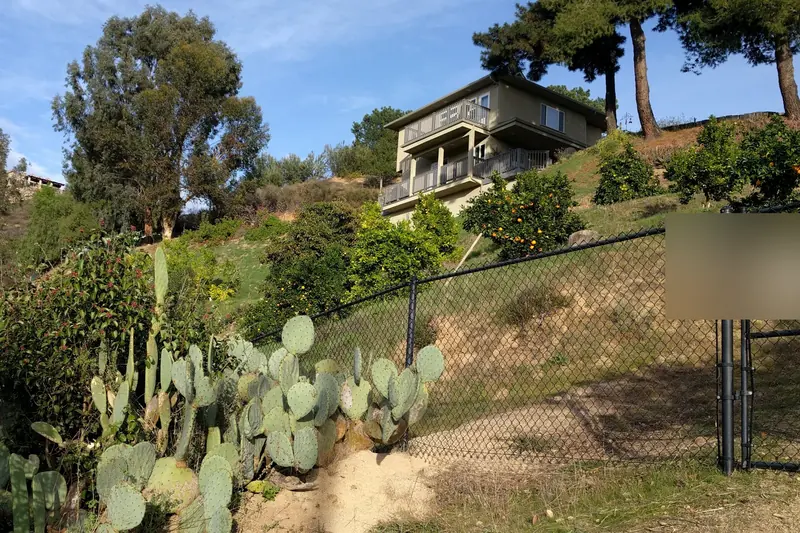
3.4.2 Why do some lots need two regulators?
Because one valve rarely suits both a long irrigated slope and the house. Rainbow explains that many properties carry two owner regulators: one at the meter that lowers pressure and protects the irrigation system, and another at the residence that lowers it again for the plumbing inside.
A valve on the district side of the meter doesn't count toward that pair. Rainbow's page on district pressures says those exist to protect the meter, not your pipes, and that every home should already have its own regulator, usually in the garage or where the line enters the house. Ownership, life span and replacement are covered on pressure reducing valves §3.2.
| Point on the property | Who controls the pressure | What to know |
|---|---|---|
| Water main in the street | The district, through its stations | Set by zone, tank levels and demand |
| Meter and first regulator | Owner, with a district valve in front in some areas | Protects irrigation lines on the slope |
| House regulator | Owner | Rainbow puts the usual owner setting near 50 psi |
3.4.3 What does high pressure damage?
Mostly the things inside the house: pipes, fixtures and appliances. Rainbow says holding pressure around 50 psi reduces stress on all three and can extend equipment life. Its list of signs that a regulator has given up includes banging in the walls, leaking faucets and a toilet that runs constantly.
The water heater is a special case. High static pressure plus a closed system makes its relief valve more likely to open, and the Rheem use and care manual links occasional discharge to thermal expansion in a closed system. That is why code pairs every regulator with an expansion tank, explained on thermal expansion tanks §3.3.
| Figure | What it is | Source |
|---|---|---|
| 80 stations | Pressure-reducing stations in Rainbow's system | Rainbow Water PRV FAQ |
| 50 stations | Pressure reducing and regulating stations in Escondido's system | City of Escondido Water Division |
| 80 psi | Static ceiling before a house regulator is required | 2025 California Plumbing Code §608.2 |
| 15 psi | Lowest residual pressure the code allows | 2025 California Plumbing Code §608.1 |
| 2 regulators | What many sloped properties need, per Rainbow Water | Rainbow Water PRV FAQ; City of Escondido Water Division; 2025 California Plumbing Code §608.2 |
3.4.4 What about low pressure at the top of a hill?
Homes near the top of a zone, close to the tank's own elevation, can see the opposite problem. Rainbow's household range starts at 30 psi, and the code's floor is 15 psi of residual pressure while water runs. Because pressure moves with tank levels and demand, a ridge-top house may notice it most when many neighbors irrigate at once.
Before blaming the district, rule out your own valves: Rainbow lists falling or wandering pressure among the signs of a failing regulator. Fire season matters here too. FPUD and Rainbow say they fill their tanks ahead of SDG&E power shutoffs, and Rainbow's backflow page notes that backflow devices matter when a wildfire drops system pressure. Preparation steps are on wildfire water prep §7.2. Any booster pump idea is for a licensed plumber and your district; Escondido lists booster pumps among the setups that need a backflow device.
3.4.5 What should you ask when buying a hillside home?
Ask about pressure the way you would ask about the roof: where the parts are, how old they are and whether they still work. A gauge reading on a house-wall hose bib, taken with everything off, gives you a number to compare against the 80 psi limit. Steps are on how to check your water pressure §3.1.
- Where is each regulator, at the meter and at the house, and roughly when was each installed? Rainbow puts typical life at 10 to 15 years.
- Is there an expansion tank on the cold line downstream of the house regulator?
- Is there a backflow device at the meter, and who tests it under the local district's rules?
- Has the relief valve on the water heater ever discharged?
- Which district serves the parcel, and has it changed pressure stations nearby?
Have a licensed plumber look at anything that comes back unclear before you close.
If you're unsure, call a licensed plumber.
3.4.6 Common questions
- Why is my pressure so different from my neighbor's up the street?
Elevation. Rainbow says local swings occur at specific properties because of elevation differences, so two houses on one street can sit at different points in the same zone.
- Can I ask the district to lower the pressure in my street?
You can ask, but the district sets main pressure by zone. Rainbow is adding larger stations to lower main pressure where possible and still says homes need their own regulator.
- Does high pressure hurt drip lines on a slope?
Rainbow describes the meter-side regulator as the one that protects the irrigation system, which is why many sloped lots have it. Running a slope without one leaves those lines exposed to street pressure.
- Does pressure change when the groves around me are watering?
It can. Rainbow says flow demand is one of the things that shifts system pressure, alongside reservoir and tank levels.
- Do hillside homes in VID, Escondido or Valley Center face the same issue?
The physics is the same everywhere, and Escondido runs 50 stations to manage it. No district statement on house regulators was found for VID, Escondido or VCMWD, so ask yours.
- Is the regulator in my meter box enough on a downhill lot?
Not if it belongs to the district. Rainbow says those protect the meter only, and it expects a customer-owned regulator as well.
3.4.7 Sources for this section
Where this comes from: three Rainbow Water pages (regulator FAQ, district pressures, backflow program), Escondido's water division overview, an FPUD notice on wildfire coordination, the state plumbing code (2025 edition, sections 608.1 and 608.2) via IAPMO and Rheem's AP21831 manual, all consulted October 2026. Contractor blogs and prices were left aside, and no property's pressure was measured by us.
Checked October 29, 2026. Inline links in the text above go to each source.