§3.1 Chapter 3 · Water pressure
How to Check Your Water Pressure
Summary. To check water pressure, thread a gauge onto a hose bib, turn off every tap and water-using appliance, open the bib and read the needle; Rainbow Water looks for 30 to 80 psi.
Section 3.1 · revised · checked against district reports, code and agency pages · about 6 min to read
Supplier note: this section links to PlumbingSupplyAndMore, owned by the people who run North County Water & Pipes. Those links are labeled examples; no figure here depends on them. About these links
3.1.1 What do you need to check water pressure?
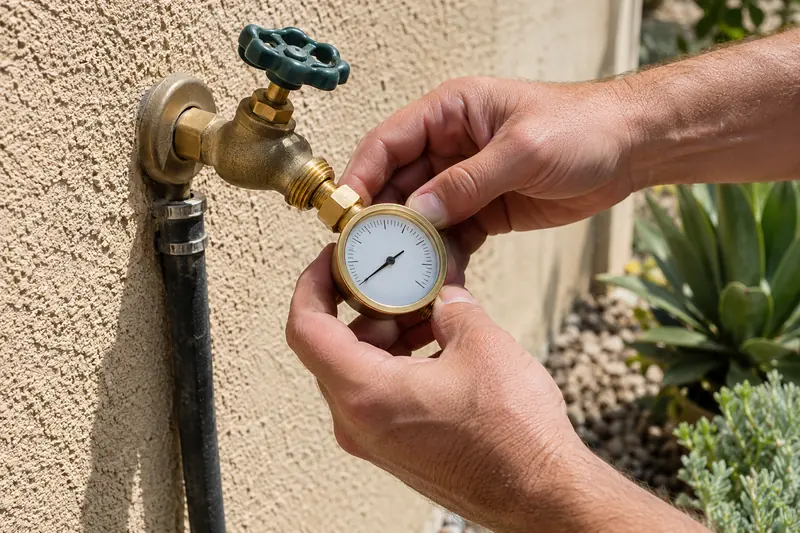
One screw-on test gauge with garden-hose threads, and a few quiet minutes when nobody is using water. Rainbow Municipal Water District suggests picking one up at a hardware store and hooking it to a hose faucet. A gauge like this hose-thread water test gauge (PlumbingSupplyAndMore, owned by the people who run North County Water & Pipes) is the whole kit, so long as its dial runs well past 80 psi and a high reading won't pin the needle.
Pick the right faucet. Rainbow notes that many properties have two regulators: one at the meter that also protects the irrigation, and a second at the house. A hose bib near the street may sit between them and read higher than the plumbing indoors. For the number your fixtures actually see, use a hose bib on the house wall, ideally near where the supply line enters.
3.1.2 How do you take the reading?
Shut everything off, open the bib, and read the dial once the needle settles. The steps below stay inside what a homeowner should touch: a faucet and a gauge.
- Turn off indoor taps, the washer, the dishwasher, the ice maker and the irrigation controller. Make sure no toilet is refilling.
- Thread the gauge onto the hose bib by hand until snug.
- Open the hose bib all the way. Water stops once the gauge is full, and the needle settles.
- Read the number and write it down with the date and time.
- Close the bib, then unscrew the gauge slowly. A little water will escape.
That figure is static pressure, the pressure with nothing flowing. Rainbow says pressure in its system moves with reservoir and tank levels and with demand, so a second check at a different hour, such as late evening, can show a swing. If you have a gas or electric tank heater, a reading taken after it has finished heating, with no water used in between, is also worth noting. The A. O. Smith gas heater manual says a properly sized expansion tank must be installed on all closed systems; why that matters is explained on thermal expansion tanks §3.3.
3.1.3 What range is normal?
Rainbow puts normal household pressure between 30 and 80 psi. Within that band, Rainbow says a house regulator is usually set near 50 psi, and Vallecitos Water District reports that most of its homeowners settle on about 50 psi too.
The code frames the edges. Section 608.2 caps static pressure at 80 psi, and §608.1 asks for at least 15 psi of residual pressure, meaning pressure while water is flowing. A reading in the 50s or 60s sits comfortably inside that band.
| Gauge reading | What it suggests | Next step |
|---|---|---|
| Under 30 psi | Below Rainbow's household range | Ask your district about system conditions, then a plumber |
| 30 to 80 psi | Inside Rainbow's household range | Keep the number for your records |
| Around 50 psi | Common regulator setting per Rainbow and Vallecitos | Nothing to do |
| Over 80 psi | Above the 2025 CPC §608.2 limit | Have a licensed plumber check or fit a regulator |
3.1.4 What are signs of high pressure?
The gauge is the only proof, but Rainbow lists warning signs of a failing regulator: pressure that drops or swings, no pressure at all, thumping or hammering noises in the walls, water leaking from faucets and a toilet that runs constantly. Several of those also show up when pressure is simply too high.
Watch the water heater as well. The Rheem use and care manual says a relief valve that discharges from time to time may point to thermal expansion in a closed system, and it tells owners to contact the water supplier or local plumbing inspector. The relief valve is a safety device. Leave it working and its outlet open, and see water heater temperature and relief valve §6.2 for what the makers say about it.
| Figure | What it is | Source |
|---|---|---|
| 30-80 psi | What Rainbow calls normal at the hose bib | Rainbow MWD, regulator FAQ |
| 80 psi | Static pressure that triggers a required regulator | Calif. Plumbing Code 2025, §608.2 |
| 50 psi | Setting most Vallecitos homeowners choose | Vallecitos Water District |
| 15 psi | Flowing-pressure floor set by state code | Calif. Plumbing Code 2025, §608.1 |
| About 50 psi | The usual setting owners pick, per Rainbow and Vallecitos | Rainbow MWD; Vallecitos WD; California Plumbing Code 2025, sections 608.1 and 608.2 |
3.1.5 What if the number is over 80 psi?
Then the house needs a working regulator, because §608.2 requires one with a strainer whenever static pressure tops 80 psi. If you already have a regulator, it may be worn or set too high. Rainbow encourages its customers to inspect and test their regulator, since a district upgrade in its area may remove the meter-side valve and leave the house valve doing all the work.
Write down the reading and call a licensed plumber to check, reset or replace the regulator. The code also wants an expansion tank downstream of each regulator, so ask about that in the same visit. If you're unsure, call a licensed plumber. Details on both are on pressure reducing valves §3.2 and high pressure on hillside lots §3.4.
3.1.6 Common questions
- Can I check pressure at a laundry tub faucet instead of outside?
Yes, if it has garden-hose threads and sits on the house side of your regulator. Outdoor hose bibs are simply the easiest spot, which is why Rainbow describes the test that way.
- Why does my gauge read differently at night than in the afternoon?
Rainbow says system pressure shifts with reservoir and tank levels and with how much water people are using. A house regulator in good shape should keep those swings small indoors.
- My pressure reads normal but one faucet is weak. Why?
A normal gauge reading points away from the supply and toward that fixture. In hard North County water, mineral scale on a faucet aerator is a common culprit, covered on hard water Chapter 2.
- What should I do with a reading under 30 psi?
Ask your water district whether there is work or an outage in your area first. If the street is normal, Rainbow lists falling pressure as a sign of a failing regulator, which is a job for a licensed plumber.
- Should I test again after a new regulator goes in?
Yes. A fresh reading confirms the setting and gives you a baseline to compare against later.
- Does a high reading mean my pipes are about to fail?
Not necessarily, but it means the house is outside the code limit. Rainbow says a regulator set around 50 psi reduces stress on pipes, fixtures and appliances and can extend their life.
3.1.7 Sources for this section
What this page draws on: Rainbow Water's FAQ on pressure regulators plus its notice on pressures around the district, the Vallecitos regulator page, IAPMO's online 2025 California Plumbing Code and Rheem's AP21831 use and care manual, read October 2026. Nothing here comes from contractor blogs or price lists, and the steps restate those sources rather than any trial run by us.
Checked October 29, 2026. Inline links in the text above go to each source.