§3.2 Chapter 3 · Water pressure
Pressure Reducing Valves
Summary. A pressure reducing valve is a spring-loaded regulator on your side of the meter that brings street pressure down to a steady level, and code requires one wherever static pressure tops 80 psi.
Section 3.2 · revised · checked against district reports, code and agency pages · about 6 min to read
Supplier note: this section links to PlumbingSupplyAndMore, owned by the people who run North County Water & Pipes. Those links are labeled examples; no figure here depends on them. About these links
3.2.1 What does a pressure reducing valve do?
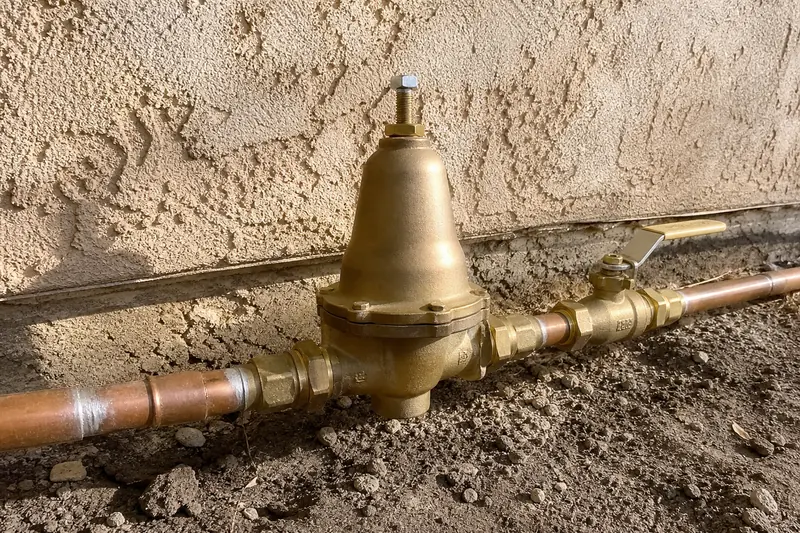
It lowers the pressure arriving from the main to a steady, lower level for everything inside the house. Rainbow Municipal Water District explains that a regulator is a spring-loaded valve controlling pressure on its downstream side, and that compressing the spring more or less changes that pressure.
Rainbow says a house regulator lets owners hold pressure where it suits their plumbing, typically around 50 psi. In the district's words, that can cut stress on pipes, fixtures and appliances, improve performance and extend equipment life. Not sure what you have now? Read a gauge first, using how to check your water pressure §3.1.
3.2.2 When does code require one?
Whenever static pressure in the supply piping is above 80 psi. Section 608.2 of the 2025 California Plumbing Code, in force since January 1, 2026, calls for "an approved-type pressure regulator preceded by an adequate strainer" and for pressure to be brought down to 80 psi or less.
The same section also wants an expansion tank on the cold line after every regulator, so heating water can't drive pressure back above 80 psi. On systems designed by a licensed plumbing contractor or registered design professional, a relief valve rated to open at no more than 100 psi may stand in for the tank. Vallecitos Water District points owners to the same section, under its model-code name, the Uniform Plumbing Code.
3.2.3 Who owns the regulator at your meter?
You own the one on your side of the meter. Rainbow states that the customer is responsible for installing and maintaining that regulator, as close as possible to the downstream side of the district meter so all of the property's plumbing is covered. Vallecitos says the same of its owners.
Some meter boxes hold a second valve on the street side. Rainbow's page on pressures in the district says those are district property and protect the meter, not the customer's lines. As Rainbow installs larger stations under its Water Service Upgrade Project, it is removing some of those meter valves, and it says every home should already have its own second regulator, usually in the garage or where the pipeline enters the house.
Many hillside parcels carry two customer regulators: one at the meter that lowers pressure and protects irrigation, and one at the residence that lowers it again. That layout is explained on high pressure on hillside lots §3.4.
| Valve | Owner | What it protects |
|---|---|---|
| District valve in front of the meter | Rainbow Water, where installed | The district meter |
| Customer valve right after the meter | Property owner | Irrigation and the rest of the property |
| Customer valve at the house | Property owner | Indoor plumbing, fixtures and the heater |
For FPUD, VID, the City of Escondido and VCMWD, no district statement on regulator ownership was found, so ask your district directly.
3.2.4 How long does a regulator last?
Usually 10 to 15 years, by Rainbow's estimate, though the district has seen one fail at three years and another still working at 20 when kept up. Rainbow adds that regulators were long called "life-of-mortgage" products, because a faulty one was often cleaned or rebuilt with a service kit rather than replaced, since grit on the valve seat causes many of the problems.
Signs that one is wearing out, from Rainbow's list, include pressure that fades or wanders, thumping in the walls, dripping faucets and a toilet that won't stop running. A gauge reading over 80 psi with a regulator in place is the clearest sign.
| Figure | What it is | Source |
|---|---|---|
| 80 psi | Static pressure above which code requires a regulator | CPC, 2025 edition, §608.2 |
| 10-15 years | Typical regulator life | Rainbow Water, pressure regulator FAQ |
| 3-20 years | Spread of regulator lifespans Rainbow has seen | Rainbow Water, pressure regulator FAQ |
| 30-80 psi | Rainbow's healthy range on a gauge test | California Plumbing Code (2025) §608.2 and Rainbow Water's PRV questions page |
| About 50 psi | Common house setting cited by Rainbow Water | California Plumbing Code (2025) §608.2 and Rainbow Water's PRV questions page |
3.2.5 What does replacement involve?
A licensed plumber shuts the water, cuts in or rebuilds the regulator with its strainer, sets the outlet pressure and confirms it with a gauge. Your part is knowing where the main shutoff is, covered on finding your main water shutoff §4.4, and having your last gauge reading ready.
Ask a few plain questions before the plumber leaves. What pressure was the valve set to? Is there an expansion tank downstream, as §608.2 requires? Was the second regulator near the meter checked too, if the lot has one? For replacement parts, a supply house such as this pressure reducing valve range (PlumbingSupplyAndMore, owned by the people who run North County Water & Pipes) shows the common sizes, but fitting one is not a homeowner job on this site. If you're unsure, call a licensed plumber.
Hire carefully. The CSLB requires a license for work of $1,000 or more in combined labor and materials, and more on vetting a plumber is on choosing a plumber §4.5.
3.2.6 Common questions
- Can a worn regulator be rebuilt instead of replaced?
Often, according to Rainbow, which says faulty regulators have long been cleaned or repaired with a service kit. A licensed plumber can tell you which makes sense for your valve.
- Where is the house regulator usually found?
Rainbow says it is usually in the garage or where the supply pipe enters the house. A second one may sit just past the meter.
- Does the valve inside my meter box protect my house?
Not if it is on the district side. Rainbow says those valves protect the meter only, so you still need your own.
- What setting should the plumber use?
Rainbow says owners typically set about 50 psi, and Vallecitos says most of its homeowners choose about the same. Code does not allow static pressure above 80 psi.
- Why does the code want a strainer in front of the regulator?
Section 608.2 requires the regulator to be "preceded by an adequate strainer." Rainbow notes that dirt on the valve seat is behind many regulator problems, which is what the strainer guards against.
- Does adding a regulator also mean adding an expansion tank?
Under §608.2, yes: a tank follows every regulator, unless the system was designed with a dedicated relief valve opening at 100 psi or below.
3.2.7 Sources for this section
Built from section 608.2 of the 2025 California Plumbing Code (IAPMO's online edition), Rainbow Water's regulator questions and its notice on district pressures, the Vallecitos regulator page and the CSLB page on which contractors need a license, checked October 2026. Contractor blogs and prices were kept out, and no regulators were bench-tested or compared for it.
Checked October 29, 2026. Inline links in the text above go to each source.