§4.4 Chapter 4 · Leaks and repairs
Your Main Water Shutoff
Summary. Your main water shutoff is the house valve on the supply line between the meter and the house; closing it stops water to every indoor fixture while you deal with a leak.
Section 4.4 · revised · checked against district reports, code and agency pages · about 7 min to read
Supplier note: this section links to PlumbingSupplyAndMore, owned by the people who run North County Water & Pipes. Those links are labeled examples; no figure here depends on them. About these links
4.4.1 Where is the main shutoff?
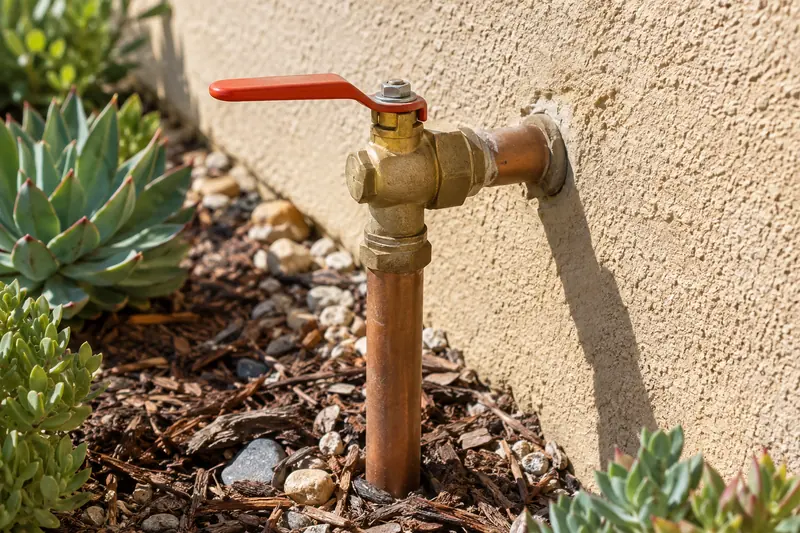
On most North County houses it's on the supply pipe between the meter and the house, often where that pipe comes out of the ground and turns into the wall. Look along the side or front of the house that faces the meter, near a hose bib, or inside the garage if the line enters there. Water districts call it the house valve: both FPUD and Valley Center MWD use that term in their leak checks.
Rural and grove properties often have more than one line leaving the meter. FPUD's sheet mentions an irrigation valve as well as the house valve, so follow every pipe you can see and label each valve with a tag or paint pen. A property with a well and district water will also have a backflow device near the meter; the backflow testing page §5.1 explains who tests it in each district.
Find the valve now, on a calm day, rather than during a leak. Make sure every adult in the house knows where it is and how it turns.
| Figure | What it is | Source |
|---|---|---|
| 80 psi | Static pressure that makes a house regulator mandatory | 2025 California Plumbing Code §608.2 |
| 10-15 years | Regulator service life that Rainbow Water cites | Rainbow MWD regulator FAQ |
| 2 | Regulators on many Rainbow properties, meter side and house side | Rainbow MWD regulator FAQ |
| $1,000 | Labor plus materials that calls for a CSLB-licensed contractor | CSLB consumer page |
4.4.2 What is the difference between the house valve and the meter valve?
The house valve is yours; the meter and the equipment on its street side belong to the water district. Some meter boxes also hold a valve on the district's side of the meter. Treat that as the district's equipment and call the district before operating it.
For an emergency, the house valve is usually enough. It shuts water to the house while the meter keeps running for anything upstream, which is why closing it is also the key step in a meter leak test §4.1. VCMWD's leak page says that if the meter still moves with the house valve closed, the leak is between the meter and that valve.
Near the house valve you may also find a pressure regulator, a bell-shaped brass valve. Rainbow Water says the customer is responsible for installing and maintaining the regulator on their side of the meter, and that the district-side regulators protect the meter, not the house. Under the 2025 California Plumbing Code, §608.2, a regulator is required where static pressure is over 80 psi. Installing, replacing or adjusting one is a job for a licensed plumber; more on that is on the pressure regulator page §3.2.
| Valve | Where it usually is | Who operates it |
|---|---|---|
| House valve | Supply pipe at the house, between meter and wall | Owner |
| Irrigation valve | Line feeding the yard or grove (FPUD) | Owner |
| District-side valve | Inside the meter box, street side of the meter | Water district |
| Fixture stop valves | Under sinks, behind toilets, at the washer | Owner |
| Pressure regulator | House side of the meter (Rainbow) | Licensed plumber for install, replacement or adjustment |
4.4.3 How do you shut the water off?
Turn the handle slowly and fully, without tools if you can. The two common types work differently:
- Ball valve (lever handle): the lever runs along the pipe when open. Turn it until it sits straight across the pipe to close.
- Gate or globe valve (round wheel handle): turn clockwise until it stops. It takes several turns.
Then open a faucet at the lowest point in the house to confirm the water has stopped and to relieve pressure in the lines. To restore water, open the valve slowly, then run each faucet until air stops spitting out.
A valve that won't budge by hand needs care. Don't hit it, use a cheater bar or stand on the handle; an old valve can snap at the stem and start a bigger leak than the one you're stopping. If it's stuck and water is pouring, call your district about shutting service at the meter.
If you evacuate for a wildfire, San Diego County's Ready, Set, Go guide tells residents to make sure sprinklers and water aren't left running.
4.4.4 What about fixture stop valves?
Stop valves let you shut off one fixture without cutting water to the house. You'll find them on the wall or floor under sinks, behind each toilet, behind the washing machine and on the dishwasher line. Most have a small oval or round handle that turns clockwise to close.
Use the stop for the small owner jobs: replacing a toilet flapper §4.2 or cleaning a faucet aerator. Faucet cartridges, toilet fill valves and supply hoses go to a plumber, and closing the stop keeps things dry until one arrives. If a stop weeps at its stem when turned, or won't close fully, shut the house valve and have the stop replaced.
4.4.5 When should a valve be replaced?
Replace a valve when it no longer does its job: it won't close fully, it drips at the stem, the handle is broken, or the body is corroded. Turning each valve closed and open now and then shows you which ones are failing before an emergency does.
On the main line, replacement is licensed plumbing work, since the water must be shut at the meter and the pipe cut and rejoined. In California, work priced at $1,000 and up (labor plus materials), or work that needs a permit, calls for a CSLB-licensed contractor; see choosing a plumber §4.5. A lever-handle ball valve closes with a short turn of the handle; this ball valve listing (PlumbingSupplyAndMore, owned by the people who run North County Water & Pipes) shows the range of sizes and end connections.
If you're unsure, call a licensed plumber.
4.4.6 Common questions
- Should the main shutoff be closed before leaving on a long trip?
It can make sense: a closed house valve limits damage if a hose or fitting fails while the house is empty. Check first whether anything needs water while you're gone, such as irrigation on a separate line.
- Does closing the house valve stop the sprinklers?
Not always. FPUD's leak sheet lists the irrigation valve separately, so on many properties the yard line branches off before the house valve.
- What does it mean if the house valve leaks at the handle?
The packing or seal around the stem is worn. Note it and have a plumber look, as it's a sign the valve may not seal well when you need it.
- Can the main shutoff be turned with a wrench?
Gentle leverage on a wheel handle is sometimes fine, but heavy force risks breaking an old valve. If it doesn't move with moderate effort, stop and get help.
- Why is there a brass bell-shaped valve near the shutoff?
That's likely a pressure regulator. Rainbow Water says homeowners own and maintain theirs and that many properties need two; adjusting or replacing it is a plumber's job.
- Where does the water heater's own shutoff sit?
On the cold-water line going into the top of the heater. Closing it isolates the heater while the rest of the house keeps water.
4.4.7 Sources for this section
This page draws on Fallbrook PUD's Check a Leak sheet, Valley Center MWD's leak page, Rainbow Water's regulator FAQ, the 2025 California Plumbing Code, CSLB consumer pages and San Diego County's wildfire guide, read October 2026. Valve operating steps are general mechanics, not taken from any district; we left out prices and brand picks.
Checked October 29, 2026. Inline links in the text above go to each source.