§4.3 Chapter 4 · Leaks and repairs
Slab Leaks
Summary. A slab leak is a break in water pipe beneath a concrete floor, and the most reliable early sign is a meter that keeps moving when every fixture in the house is off.
Section 4.3 · revised · checked against district reports, code and agency pages · about 7 min to read
4.3.1 What is a slab leak?
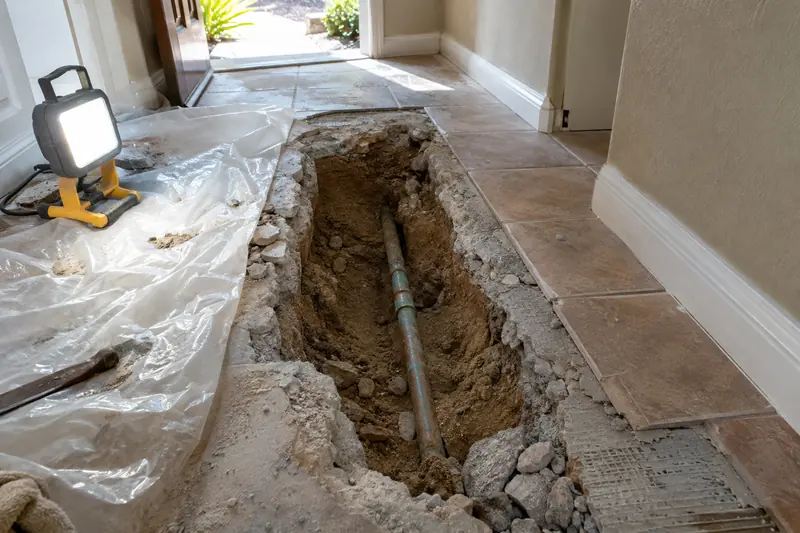
It's a leak in a supply pipe that runs under or within a concrete floor slab, where you can't see it. In a house built on a concrete slab, some of the water lines may run beneath the floor rather than through walls or an attic. When one of those lines fails, the water goes into the soil or gravel under the house rather than onto a floor you can see.
That makes slab leaks hard to spot by eye. Damp flooring or unexplained water can show up, but none of those clues is reliable on its own, and we found no district or state guide that lists visible signs. What the districts do describe is a meter test, and that is where to start.
4.3.2 How does a meter test point to one?
It works by elimination. You show that water is moving, show that it's moving on the house side of the main valve, and then rule out every fixture you can see.
First, turn off all water use and read the meter. FPUD's method is to read it, wait 15 minutes, and read it again; if the numbers differ and the red flow indicator is turning, there may be a leak. In Valley Center, the small red "Tattle Tell" dial does the same job, and VCMWD's leak page says a moving dial with everything off means water is running somewhere.
Next, close the house valve and watch again.
| House valve | Meter | What the districts say it means |
|---|---|---|
| Open, all fixtures off | Moving | Water is leaving somewhere on the property |
| Closed | Still moving | Leak is before the house valve: service line or irrigation (FPUD), or between meter and house valve (VCMWD) |
| Closed | Stopped | Leak is after the house valve, in the house plumbing (FPUD) |
A stopped meter with the valve closed sends you indoors. FPUD's sheet names the places to check: toilets, faucets, the water heater, the AC unit and the washer. Run a toilet dye test §4.2, look under sinks, and check around the water heater and any softener or ice maker line.
If every fixture is dry and the meter still turns with the house valve open, hidden pipe is the likely source: in a wall, under the slab, or in the short run between the house valve and the foundation. That conclusion is an inference from the district tests, not a diagnosis, and it's the point to bring in a plumber. Step-by-step meter reading is on the water meter page §4.1.
4.3.3 What does leak detection involve?
It's the work of pinpointing where under the floor the pipe has failed, and it is licensed plumbing work. In California a plumbing contractor holds the CSLB's C-36 license, and the CSLB requires a licensed contractor whenever a job's combined labor and material cost is $1,000 or higher, per the CSLB.
We found no state or district guide that describes detection methods, so ask the plumber to explain theirs in plain terms. A clear answer usually covers how they will isolate the hot and cold lines, how they will confirm the location before cutting concrete, and what happens if the first opening misses. Get the plan and the price in writing before work starts.
Keep your meter readings and dates. They show when the loss began and help if you ask your district about a bill adjustment.
4.3.4 Is it better to repair or reroute?
Neither option wins every time; it depends on the pipe, the house and how many failures you've had. A plumber will usually describe three paths, and it helps to know the words.
| Option | What it means | Questions to ask |
|---|---|---|
| Spot repair | Open the slab at the leak and repair that section of pipe | How much floor comes up? How is the floor patched? Is a permit needed? |
| Reroute | Abandon the line under the slab and run new pipe through walls or the attic | Which fixtures move to the new line? What walls get opened? |
| Repipe | Replace most or all of the house's supply piping | Is the rest of the pipe in poor shape? What permit and inspections apply? |
A spot repair keeps the original layout but means breaking concrete and flooring. A reroute leaves the old line in place, disconnected, and avoids the slab. A repipe makes sense when the plumber finds the pipe failing in several places, but ask what evidence they found.
Get more than one opinion on a big job. Check each license at cslb.ca.gov, and remember that the CSLB caps a down payment at 10% of the contract price or $1,000, whichever is less. The choosing a plumber page §4.5 covers contracts and cancellation rights.
4.3.5 Does a repipe need a permit?
In unincorporated San Diego County, yes. The County's permit-exemption list, PDS 110, says that when defective material must be removed and replaced, the work is considered new work and requires a permit and inspection. That covers most repipes and reroutes. Fallbrook, Bonsall, Rainbow and Valley Center fall under the County.
Escondido and Vista are cities with their own building departments, so check with the city before work begins. In either case, ask the plumber who will get the permit and when the inspection happens, and keep the final sign-off with your house papers.
| Figure | What it is | Source |
|---|---|---|
| 15 minutes | Gap between meter readings in FPUD's leak check | Fallbrook PUD Check a Leak |
| $1,000 | Job size that requires a CSLB-licensed contractor | Contractors State License Board |
| 10% or $1,000 | Most a contractor can take as a down payment, whichever is less | Contractors State License Board |
| 1 billing period | Span of a VID leak adjustment | Vista Irrigation District |
4.3.6 Common questions
- Should the water stay off while waiting for a slab repair?
If the meter shows heavy flow, closing the house valve between uses limits the loss. The plumber can tell you whether the leaking line can be isolated so the rest of the house stays in service.
- Can a slab leak be on the hot side only?
It can be on either line. Part of locating it is working out which line is losing water, so ask the plumber how they will tell hot from cold.
- Will the district lower the bill after a slab leak?
Policies vary. Vista Irrigation District offers adjustments for undetected, unintentional leaks on private plumbing, for one billing period, and says charges won't be waived entirely. Ask your own district what it offers.
- Who owns the pipe between the meter and the house?
Ask your district where its responsibility ends. A leak that shows with the house valve closed sits in that stretch, which VCMWD places between the meter and the house valve.
- Is a reroute allowed without a permit in Fallbrook?
Fallbrook is in unincorporated San Diego County, where replacing defective concealed pipe counts as new work that needs a permit and inspection. Confirm the details with County Planning & Development Services.
- Does a slab leak mean the whole house needs repiping?
Not necessarily. One failure may call for a spot repair or reroute. Ask what the plumber found about the rest of the piping before agreeing to a full repipe.
4.3.7 Sources for this section
This page relies on Fallbrook PUD's Check a Leak sheet, Valley Center MWD's leak page, CSLB consumer pages, San Diego County's PDS 110 permit list and Vista Irrigation District's leak-adjustment page, read October 2026. We left out commonly repeated slab-leak signs that no primary source confirms, plus all repair prices.
Checked October 29, 2026. Inline links in the text above go to each source.