§4.2 Chapter 4 · Leaks and repairs
Toilet and Faucet Leaks
Summary. A toilet leak is easiest to confirm with EPA's dye test: color in the tank, no flushing, and any color in the bowl after 10 minutes means water is slipping past the flapper.
Section 4.2 · revised · checked against district reports, code and agency pages · about 6 min to read
Supplier note: this section links to PlumbingSupplyAndMore, owned by the people who run North County Water & Pipes. Those links are labeled examples; no figure here depends on them. About these links
4.2.1 How do you find a toilet leak?
Use food coloring. Take the tank lid off, add a few drops of dye to the tank water, and leave the toilet alone. EPA says that if any color shows up in the bowl after 10 minutes, you have a leak. That color has seeped through the flapper, the rubber seal at the bottom of the tank.
Two other clues are worth a look. A toilet that hisses or refills by itself every so often is losing water somewhere. Water trickling into the open top of the overflow tube, the upright pipe in the middle of the tank, usually means the fill valve isn't shutting off at the right level.
The dye test only covers the toilet. To check the whole property at once, use the water meter test §4.1 first, then come back here if the leak is on the house side.
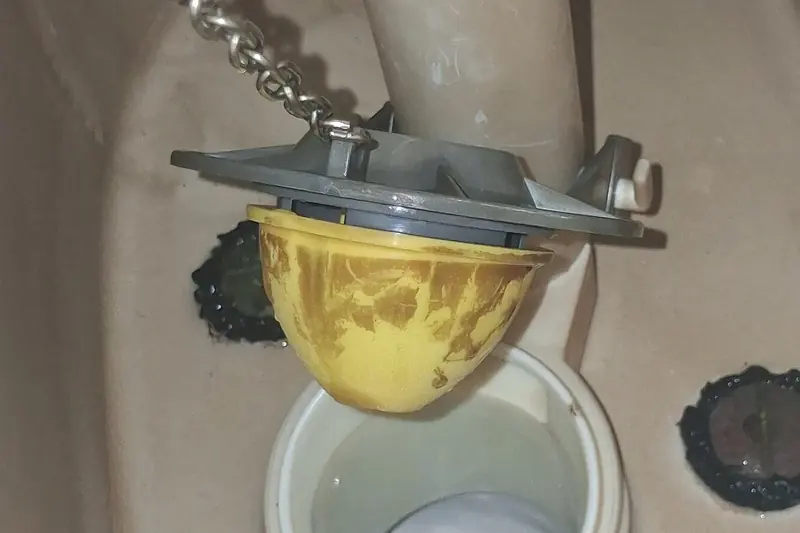
4.2.2 What usually fails inside the tank?
The flapper is the most common culprit, and it's also the cheapest fix. Over time the rubber hardens, warps or picks up deposits, and it stops sealing against the drain opening. EPA's advice is to replace it at least every five years, even before it fails.
The fill valve is the second suspect. It refills the tank after a flush and should close when the float rises. If it sticks open, water runs into the overflow tube and down the drain without stopping. Fill valve repair or replacement is a job for a plumber; the owner's part is spotting the sign and closing the stop behind the toilet.
| Part | What you notice | Usual fix |
|---|---|---|
| Flapper | Dye in the bowl, toilet refills on its own | Owner swaps the flapper |
| Fill valve | Water running into the overflow tube, hissing | Plumber; owner closes the stop valve meanwhile |
| Faucet aerator | Weak, sputtering stream | Owner unscrews and cleans the screen |
| Faucet cartridge or washer | Steady drip from the spout | Plumber |
| Stop valve or supply line | Won't close, or weeps at the fitting | Plumber |
Replacing a flapper starts with closing the stop valve on the wall behind the toilet and flushing to empty the tank. Match the new part to your toilet's flush valve size; a parts supplier's toilet section, such as this toilet parts listing (PlumbingSupplyAndMore, owned by the people who run North County Water & Pipes), shows how many sizes and styles exist.
4.2.3 How much does a dripping faucet waste?
More than people expect. EPA figures that a faucet dripping once a second wastes more than 3,000 gallons a year. Across a house, leaks add up even faster: EPA estimates an average household's leaks waste more than 9,300 gallons a year, and that fixing the easy ones saves about 10% on water bills.
A drip from the spout with the handle fully closed usually means a worn cartridge or washer inside the faucet. A drip from under the handle or around the base points to a seal. Which part is worn depends on the faucet's maker and model, and taking the faucet apart is a job for a plumber. Note any brand mark or the original paperwork to pass along, and close the stop under the sink if the drip is heavy.
| Figure | What it is | Source |
|---|---|---|
| 10 minutes | Wait for EPA's toilet dye test | EPA WaterSense Fix a Leak Week |
| 3,000+ gallons | Yearly waste from one drip per second | EPA WaterSense Fix a Leak Week |
| About 10% | Water bill savings from fixing easy leaks | EPA WaterSense Fix a Leak Week |
| 235 mg/L | FPUD average hardness, 2025 data (13.7 grains per gallon) | Fallbrook PUD 2026 water quality report |
| 5 years | Longest EPA says to keep a toilet flapper | EPA Fix a Leak Week; Fallbrook PUD 2026 water quality report |
| 13.7 gpg | FPUD's 2025 average hardness (235 mg/L) | EPA Fix a Leak Week; Fallbrook PUD 2026 water quality report |
4.2.4 Why does hard water wear out parts?
North County tap water carries a heavy mineral load. In 2025 data, Fallbrook PUD averaged 235 mg/L of hardness, or 13.7 grains per gallon. Rainbow Water averaged 230 mg/L and Escondido 215 mg/L. Anything over 180 mg/L is "very hard" under the USGS classes.
Those minerals leave white scale where water sits or evaporates: on aerator screens, showerheads, valve seats and the rim of a flapper. Scale can stop a seal from closing fully, which turns into a slow drip or a running toilet. USGS notes that scale from heated hard water shortens equipment life; for cold-water parts like flappers, we found no district or federal figure on how much faster they wear here, so treat EPA's five-year flapper advice as a ceiling, not a target.
Cleaning aerators and showerheads is routine owner work. For more on what the minerals do and whether treatment makes sense, see the hard water section Chapter 2.
4.2.5 Which fixes need a plumber?
Call one for anything past the dye test, a flapper swap and aerator cleaning. A sticking fill valve, a worn faucet cartridge or washer, a stop valve that won't close, a supply line that weeps at its fitting, water on the floor around the toilet base, or a crack in the tank or bowl all go to a plumber.
A plumber is also the right call if the meter still shows flow after every toilet and faucet checks out. That points to hidden pipe, covered on the slab leak page §4.3. In California, a CSLB license is needed once labor plus materials hit $1,000.
4.2.6 Common questions
- Can a toilet leak without any sound?
Yes. A flapper that seeps slowly can be silent and still move water into the bowl all day. The dye test catches it even when you hear nothing.
- Why does the toilet refill by itself at night?
Water is draining from the tank into the bowl until the fill valve kicks on to top it up. That pattern points to the flapper or its seat.
- Do blue tank tablets cause leaks?
We found no primary source that addresses tank tablets. If you use them, check the flapper for warping or residue when you run the dye test.
- How do you clean scale off a faucet aerator?
Unscrew the aerator from the spout, rinse out loose grit, and soak the screen in white vinegar to loosen the mineral scale. Rinse it and screw it back on hand-tight.
- Should the water be turned off before changing a flapper?
Yes. Close the stop valve behind the toilet and flush to empty the tank, so you can reach the flapper without water running.
- Can a leaking toilet raise the bill noticeably?
It can. EPA finds that 9% of homes lose at least 50 gallons daily to leaks, and a toilet that runs between flushes is an easy place to start looking.
- What if the stop valve under the sink won't turn?
Don't force it, since an old valve can break or start leaking at the stem. Close the main shutoff §4.4 if you must stop the water, and have a plumber replace the stop.
4.2.7 Sources for this section
Figures here come from EPA's Fix a Leak Week page, Fallbrook PUD's 2026 report (2025 data), the Rainbow and Escondido 2025 water quality reports, and the USGS hardness page, all read October 2026. We left out repair prices, part brand comparisons and any claim about wear rates that no primary source states.
Checked October 29, 2026. Inline links in the text above go to each source.