Chapter 4 of 7
Finding Leaks and Getting Repairs
Summary. Leaks in a North County house usually show up first at the water meter: with every tap off, a moving dial or red indicator means water is escaping somewhere.
Chapter 4 · revised · checked against district reports, code and agency pages
Sections in this chapter
- 4.1Reading Your Water Meter for Leaks6 min
To read your water meter for leaks, shut off all water use, note the register and flow indicator, wait 15 minutes, and read again; any change means water is flowing somewhere.
- 4.2Toilet and Faucet Leaks6 min
A toilet leak is easiest to confirm with EPA's dye test: color in the tank, no flushing, and any color in the bowl after 10 minutes means water is slipping past the flapper.
- 4.3Slab Leaks7 min
A slab leak is a break in water pipe beneath a concrete floor, and the most reliable early sign is a meter that keeps moving when every fixture in the house is off.
- 4.4Your Main Water Shutoff7 min
Your main water shutoff is the house valve on the supply line between the meter and the house; closing it stops water to every indoor fixture while you deal with a leak.
- 4.5Choosing a Licensed Plumber6 min
Choosing a plumber in California starts with the license: look for a CSLB C-36 plumbing contractor, check the number at cslb.ca.gov, and keep any deposit within the state's cap.
Chapter overview
How do you know if you have a leak?
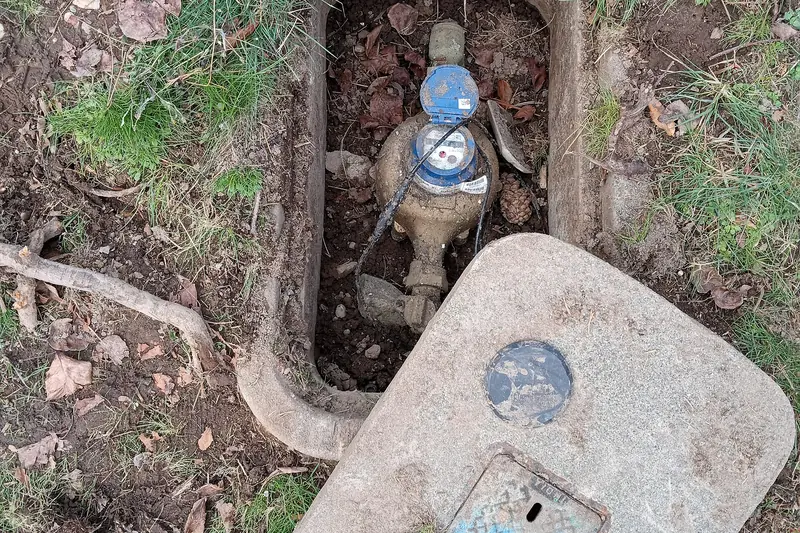
The water meter tells you before the bill does. Turn off every faucet, appliance and sprinkler, then read the meter twice. Fallbrook PUD's Check a Leak sheet asks for a 15-minute wait between readings; if the numbers differ and the red flow indicator is moving, you may have a leak. EPA suggests a longer version: read before and after a two-hour stretch when no one uses water.
Valley Center customers can watch the small red "Tattle Tell" dial instead. VCMWD's leak page says that if it turns with everything off, water is running somewhere in the system. Closing the house valve then splits the yard and service line from the plumbing indoors.
A gas leak is a different emergency, and this site covers water only. If you smell gas or hear hissing near a gas appliance or meter, leave the building first. Don't switch lights or appliances on or off, don't light anything, and don't use anything that could spark inside. From outside, at a safe distance, call SDG&E's gas emergency line or 911, as SDG&E's gas leak page directs.
See also · Finding leaks
| Figure | What it is | Source |
|---|---|---|
| 9,300+ gallons | Water lost to leaks in an average household each year | EPA Fix a Leak Week |
| 9% | Homes whose leaks run to 50 gallons or more a day | EPA Fix a Leak Week |
| 3,000+ gallons | Yearly waste from one drip per second at a faucet | EPA Fix a Leak Week |
| 15 minutes | Gap between the two readings in FPUD's meter check | FPUD Check a Leak sheet |
| $1,000 | Job size at which California requires a CSLB license | EPA Fix a Leak Week; FPUD Check a Leak; CSLB |
Which leaks can you fix yourself?
Toilets and faucets are the usual owner-sized jobs. The EPA dye test is simple: a few drops of food coloring in the tank, and color in the bowl after 10 minutes means the flapper is letting water through. Swapping a worn flapper, cleaning a faucet aerator and closing a fixture stop valve are all within reach for most owners.
Small drips add up. EPA counts more than 3,000 gallons a year from a faucet that drips once a second, and it says fixing easy household leaks can trim about 10% from a water bill. North County water is very hard (FPUD averaged 235 mg/L in 2025 data), so mineral scale on aerators and valve seats is common; the hard water section Chapter 2 explains what that means for fixtures.
What about leaks under the slab?
A slab leak is a break in supply pipe that runs beneath a concrete floor, and the meter is your best early clue. If the meter keeps moving after you close the house valve, FPUD says the leak is before that valve, in the service line or irrigation side. If it stops, the leak is after the valve, inside the house plumbing, and fixtures come first in the search.
When toilets, faucets, the water heater and appliances all check out, hidden pipe becomes the suspect. Finding and repairing it, or rerouting new pipe around the slab, is work for a licensed plumber. Under San Diego County's permit rules, swapping out failed pipe hidden in a wall or floor is new work, so a permit and an inspection follow.
See also · Hidden leaks
When do you need a licensed plumber?
Anything past fixtures and stop valves belongs to a pro: main-line repairs, slab work, repipes and replacing a stiff main shutoff valve. California's Contractors State License Board licenses plumbers under the C-36 classification. Since January 1, 2025, a license is required once a job's labor and materials together reach $1,000, and for permitted work at any price, per the CSLB.
Before the work starts, check the license number at cslb.ca.gov. A down payment can't exceed 10% of the price or $1,000, whichever is less.
| Problem | First check | Who usually handles it |
|---|---|---|
| Running toilet | Dye test, 10 minutes (EPA) | Owner: flapper swap |
| Dripping faucet | Watch the spout; once a second is 3,000+ gallons a year (EPA) | Owner: clean the aerator; plumber for a cartridge or washer |
| Meter moves, house valve closed | Close the irrigation valve too (FPUD) | Plumber for the service line; district for its own side |
| Meter stops, house valve closed, fixtures fine | Suspect hidden pipe | Licensed plumber; permit for concealed pipe (County) |
| Stiff or leaking main valve | Try it gently; don't force it | Licensed plumber |
Common questions
- Can a leak show up on the bill before any water appears?
Yes. A leak in buried pipe or under a floor can run for weeks without a puddle, which is why the meter test comes first. A higher bill with no change in habits is a reason to run it.
- Should I use the meter test or the dye test first?
Start with the meter, since it covers the whole property at once. If it shows flow, the dye test is a quick way to rule toilets in or out.
- Does my water district fix leaks on my side of the meter?
Districts generally handle their own pipes and meter, while plumbing on the house side is the owner's. Ask your district where its responsibility ends before calling anyone.
- Is a slow drip worth fixing right away?
EPA's figure of more than 3,000 gallons a year from a once-a-second drip says yes. In Vista Irrigation District, Level 1 rules also require leaks to be repaired within 48 hours of a district notice.
- What if the smell is gas, not a water problem?
Leave the building first, without switching anything on or off. Once well away from the house, call SDG&E's gas emergency line or 911.
- How often should a toilet flapper be replaced?
EPA's Fix a Leak Week guidance says at least every five years. Sooner if the 10-minute dye test puts color in the bowl, since that means the flapper is already letting water through.
Sources
This hub draws on EPA's Fix a Leak Week page, the leak-check guides from Fallbrook PUD and Valley Center MWD, SDG&E's gas leak steps, CSLB consumer pages and San Diego County's PDS 110 permit list, each read in October 2026. Contractor blogs, repair prices and any testing of our own were kept out.
Checked October 29, 2026. Inline links in the text above go to each source.