Chapter 6 of 7
Water Heaters in Hard-Water Country
Summary. Water heaters in inland North County run on very hard water, so scale, a 120°F setting, the relief valve, earthquake strapping and replacement permits all deserve an owner's attention.
Chapter 6 · revised · checked against district reports, code and agency pages
Supplier note: this section links to PlumbingSupplyAndMore, owned by the people who run North County Water & Pipes. Those links are labeled examples; no figure here depends on them. About these links
Sections in this chapter
- 6.1Scale and Flushing a Water Heater6 min
A water heater flush clears the sediment that North County's very hard water leaves in a tank, and the safe way to do it is the method and interval printed in your heater's own manual.
- 6.2Temperature and the Relief Valve7 min
Water heater temperature should start at about 120°F, the setting DOE, SDG&E and A.
- 6.3Earthquake Straps for Water Heaters6 min
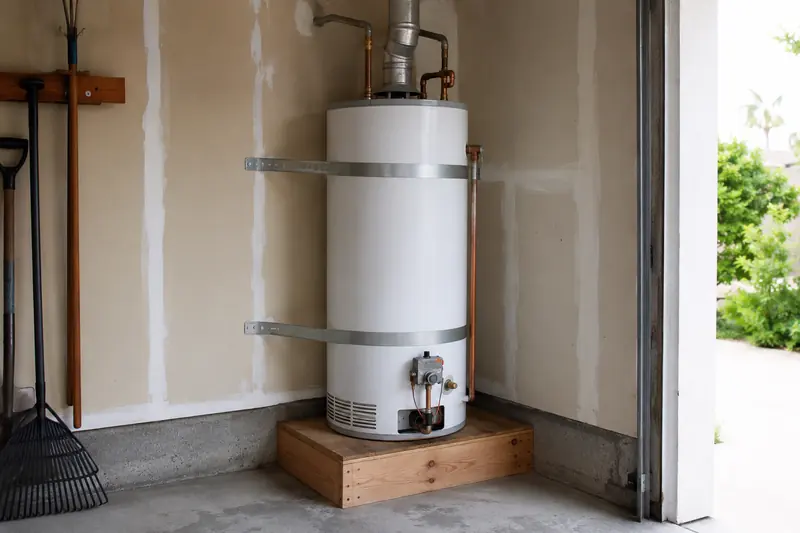
Water heater earthquake straps are required by California law on every residential tank, set in the upper third and lower third of its height with the lower strap at least 4 inches above the controls.
- 6.4Replacing a Water Heater7 min
Water heater replacement in North County is licensed work whose permit rules depend on the jurisdiction: unincorporated County areas exempt like-for-like swaps, Escondido requires a permit, and Vista residents should check with the city.
Chapter overview
What does hard water do to a heater?
Heating hard water pulls calcium out of solution, and it settles in the tank as scale and sediment. The USGS notes that this scale can shorten equipment life and lowers the efficiency of electric water heaters (USGS). Rheem's manual for its high-efficiency gas tanks adds that deposits build faster at higher temperatures (Rheem AP21831).
Almost every tap in the area is well above Rheem's 0-5 grain line. The table uses each district's 2025 data; grains are hardness divided by 17.1, the conversion FPUD and Rainbow print. For a closer look at the numbers by neighborhood, see how hard North County water is §2.1.
| District | Average hardness | Grains per gallon | USGS class |
|---|---|---|---|
| Fallbrook PUD | 235 mg/L (range 200-270) | 13.7 | Very hard |
| Rainbow Water | 230 mg/L | 13.45 | Very hard |
| City of Escondido | 215 mg/L (range 210-230) | About 12.6 (our math) | Very hard |
| Vista Irrigation District | 54-310 mg/L, by source | 3.2-18.1 | Soft to very hard |
| Valley Center MWD | Only by source: Skinner water 230 mg/L, desal from Carlsbad 60.5 mg/L | Roughly 13.5 and 3.5 (our conversion) | Very hard; moderately hard |
The practical upshot is sediment management. The scale and flushing page §6.1 compares what each maker tells owners and why the interval printed in your own manual wins. A. O. Smith's gas manual goes further: it recommends water softening or threshold-type treatment where water is hard (A. O. Smith 324257).
| Figure | What it is | Source |
|---|---|---|
| 13.7 gpg | Fallbrook PUD 2025 average hardness, 235 mg/L | FPUD 2026 water quality report |
| 0-5 grains | Soft-water band; above it Rheem says tank scale accumulates | Rheem AP21831 manual |
| 6 months | A. O. Smith's drain-and-flush interval for its gas tanks | A. O. Smith 324257 manual |
| 3 months | DOE interval for draining a quart to clear sediment | DOE Energy Saver Guide 2022 |
| 120°F | Setting named by DOE and SDG&E | FPUD 2026 report; Rheem AP21831; DOE Energy Saver Guide; SDG&E; 2025 California Plumbing Code §507.2 |
| 4 inches | Minimum gap between the lower strap and the controls | FPUD 2026 report; Rheem AP21831; DOE Energy Saver Guide; SDG&E; 2025 California Plumbing Code §507.2 |
| 18 inches | Ignition height above a garage floor, per SDG&E | FPUD 2026 report; Rheem AP21831; DOE Energy Saver Guide; SDG&E; 2025 California Plumbing Code §507.2 |
What setting is safe?
About 120°F is the number every source here agrees on. The DOE's Energy Saver Guide calls 120°F a temperature considered safe for most people (DOE). SDG&E asks for 120°F or less to reduce scalding, and notes that a dishwasher without a booster heater may need 140°F (SDG&E appliance safety).
A. O. Smith ships its thermostat at the lowest setting and marks roughly 120°F as the preferred starting point. Higher settings raise scald risk and, per Rheem, speed up scale. The temperature and relief valve page §6.2 covers the dial, the scald cautions and what each manual says about the T&P lever.
What does California require?
State law requires bracing, anchoring or strapping on residential water heaters, whether new, replacement or existing, under Health & Safety Code 19211 (California Legislature). The 2025 California Plumbing Code §507.2 puts the straps in the upper third and lower third of the heater, with the lower strap at least 4 inches above the controls (IAPMO 2025 CPC). SDG&E adds that restraints belong on wall studs.
Garage gas heaters have one more rule: SDG&E says the pilot or other ignition source must sit at least 18 inches above the floor, though flammable-vapor-resistant (FVIR) units may be exempt. Homes with a pressure regulator or check valve also need thermal expansion control; see expansion tanks §3.3. The earthquake straps page §6.3 walks through placement and the seller's certification.
When is it time to replace?
None of the sources read for these pages gives a lifespan in years, so none is offered here. What they do show is that hard water shortens equipment life, and that replacement is licensed work: the gas hookup, the vent, the burner and the relief valve all belong to a licensed plumber.
Paperwork depends on where you live. Fallbrook, Bonsall, Rainbow and Valley Center sit in unincorporated County territory, where the County's PDS 110 form (revised January 2026) exempts a like-for-like replacement done by a licensed plumbing contractor. Escondido requires a permit for any water heater replacement, and Vista is a city with its own building department, so check with the city. Details and quote checks are on the replacement and permits page §6.4.
Any gas odor or hissing by the heater means everyone leaves the house first. Don't switch lights or appliances on or off, light anything or use anything that could spark inside; call SDG&E's gas emergency line or 911 once you are outside (SDG&E gas leaks). If you're unsure, call a licensed plumber.
Common questions
- Is a water heater in Fallbrook harder on parts than one on softer water?
By the sources here, yes in direction if not in years. FPUD's 13.7 grains sits well past the point where Rheem expects scale, and USGS links heated hard water to shorter equipment life. No source puts a number of years on the difference.
- Does Valley Center water vary enough to change heater care?
It can. VCMWD lists hardness per source and prints no blended figure: 230 mg/L in its Skinner water, 60.5 mg/L in the Carlsbad desal supply, or about 13.5 and 3.5 grains as we convert them. Plan maintenance for the harder number unless you know which source reaches your street.
- Who handles a heater problem that involves gas?
A licensed plumber or a technician qualified in gas appliance repair, which is how Rheem's manual puts it for relief-valve and venting inspection. A smell of gas is different: leave the building first, then call SDG&E or 911 from outside.
- Do the strapping rules differ between Escondido, Vista and the County?
No. Health & Safety Code 19211 is state law and covers residential heaters everywhere in California. What differs is the replacement permit: exempt for like-for-like swaps in the unincorporated County, required in Escondido, and a question for the City of Vista.
- Does a pressure regulator change anything for the water heater?
Yes. A regulator stops expanding hot water from flowing back to the main, so the 2025 California Plumbing Code §608.2 adds an expansion tank downstream of it. Rheem's manual links an occasionally discharging relief valve to that kind of closed system, and A. O. Smith says a properly sized expansion tank belongs on all closed systems.
- Why are so many garage water heaters raised off the floor?
Because of an SDG&E rule for garages: the flame that lights a gas heater has to be 18 inches or more off the floor. Heaters built to resist flammable vapors, sold as FVIR units, may not need the lift; the label on the tank tells you which kind you own.
Sources
The water heater pages draw on what FPUD, Rainbow, VID, Escondido and VCMWD reported for 2025, owner manuals from A. O. Smith (324257) and Rheem (AP21831), DOE, SDG&E, USGS, the 2025 California Plumbing Code, Health & Safety Code 19211 and the County's PDS 110 form; everything was read in October 2026. Installed-price quotes, contractor marketing and lifespan claims without a primary source were kept out.
Checked October 29, 2026. Inline links in the text above go to each source.