§5.2 Chapter 5 · Irrigation and backflow
Watering a Hillside Lot
Summary. Watering hillside lots without runoff comes down to short repeated cycles, drip where plants allow it, a controller that follows the weather, and checking the meter for broken lines.
Section 5.2 · revised · checked against district reports, code and agency pages · about 7 min to read
5.2.1 Why does water run off slopes?
Water runs off when a sprinkler puts it down faster than the soil can take it in, and on a slope gravity carries the surplus downhill before it soaks in. EPA names steep slopes and clay soils as the two conditions where this is most likely. Many inland North County lots have one or both: UC ANR notes that local groves often sit on steep decomposed-granite hillsides, which drain quickly once wet but still shed water from a heavy spray.
Runoff is also a rules issue in parts of the area. Vista Irrigation District's Level 1 rules ban runoff and overspray outright, and FPUD's voluntary measures ask customers to eliminate runoff from landscape irrigation. The full picture by district is on our watering rules page §7.1.
5.2.2 How does cycle-and-soak work?
You split one long watering into several short runs with a pause between them, so each run soaks in before the next one starts. EPA's method is simple: run a zone, time how long it takes for water to start pooling or trickling off, and treat that time as the longest a single cycle should last.
- Pick a zone on the slope and start it from the controller.
- Watch the surface and note the minutes until water pools or begins to move downhill.
- Divide the zone's total run time into cycles no longer than that.
- Set a gap between starts so the water has time to sink in.
- Recheck after a few weeks and after heavy rain changes the soil.
As an example of the arithmetic, a zone that pools after 4 minutes but needs 12 minutes in all would get three 4-minute starts. Many controllers have a cycle-and-soak or multiple-start-time setting; the controller's manual shows how to set it.
Each cycle has to fit inside your district's watering hours, which makes the windows below worth knowing before you program anything.
| District | Sprinkler hours | Drip and hand watering | After rain |
|---|---|---|---|
| Vista Irrigation District | Until 8 a.m., then from 6 p.m. (mandatory, Level 1) | Allowed at any hour; hoses need a shutoff nozzle | Banned while it rains and for 48 hours after |
| City of Escondido | 6 p.m. to 10 a.m. (Municipal Code) | Shutoff nozzle required on hoses | Banned during rain and for the next 48 hours |
| Fallbrook PUD | 6 p.m. to 10 a.m. for spray (voluntary, Normal Conditions) | No separate rule found | Avoid watering after measurable rain (voluntary) |
| Rainbow Water | Current level not confirmed; check with Rainbow | Check with Rainbow | Check with Rainbow |
| Valley Center MWD | Current level not confirmed; check with VCMWD | Check with VCMWD | Check with VCMWD |
5.2.3 When is drip better than spray?
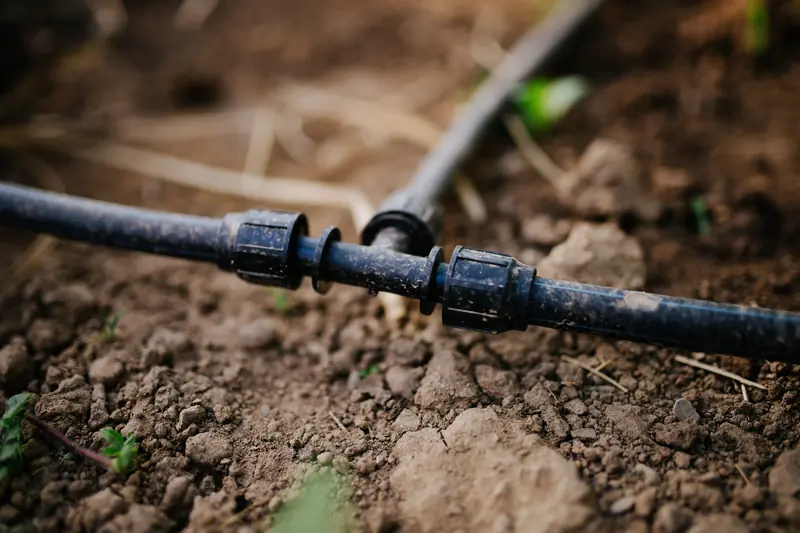
On most planted slopes, drip is the better fit, because it delivers water slowly at each plant instead of throwing it across the surface. EPA's brochure is blunt that sprinkler irrigation "is not necessarily recommended on steep slopes", while acknowledging that many homeowners have it anyway. In Vista, the Level 1 rules also let drip run at any hour, which gives you more room to split cycles.
Spray still makes sense on lawn or ground cover that drip cannot reach evenly. If you keep spray heads on a slope, cycle-and-soak matters even more. SoCal Water$mart lists a rebate for rotating sprinkler nozzles, covered on our rebates page §5.4.
Matching the system to the slope
- Trees and shrubs on a bank
Drip emitters or a drip line at each plant, run in short cycles so water does not track down the line and puddle at the bottom.
- Ground cover or turf on a gentle grade
Spray or rotating nozzles, split into cycles no longer than the pooling time.
- Mixed plantings
Group plants with similar needs on the same valve, which Escondido calls hydrozoning, so one zone does not overwater another.
5.2.4 What do smart controllers save?
EPA estimates that a WaterSense-labeled controller can save an average home up to 15,000 gallons a year. The reason is the size of the waste it targets: EPA cites expert estimates that as much as 50% of residential outdoor water is lost to overwatering. A weather-based controller changes run times as conditions change rather than repeating a fixed schedule every day of the year.
On a hillside, the controller is also where cycle-and-soak lives, so a model that supports multiple starts per zone is worth having. Controller rebates differ from one agency to the next; the VCMWD rebate listing lists up to $200 for properties under one acre.
| Figure | What it is | Source |
|---|---|---|
| 15,000 gallons | Yearly savings EPA gives for a WaterSense controller in an average home | EPA WaterSense |
| 50% | Share of residential outdoor water EPA says can be lost to overwatering | EPA WaterSense |
| 48 hours | No-irrigation period after measurable rain in Vista | Vista Irrigation District |
| 15 minutes | Gap FPUD leaves between the first and second meter reading | EPA WaterSense; FPUD Check a Leak; Vista Irrigation District Level 1 |
5.2.5 How do you find a broken line?
Start at the water meter. A soggy patch below a valve or an unusually green streak on a dry bank is a clue, but the meter tells you whether water is moving when nothing should be. FPUD's Check a Leak sheet gives the steps:
- Turn off every fixture and the irrigation controller.
- Read the meter, then read it a second time 15 minutes later. Different numbers and a moving red flow indicator point to a leak.
- Close the house valve and repeat. If the numbers still change, the leak is before the house valve, on the service line or the irrigation side.
- Close the irrigation valve and repeat to narrow it further.
In Valley Center, the small red "Tattle Tell" dial does the same job; VCMWD says that if it moves with everything off, water is running somewhere. EPA's version uses a two-hour wait between readings. A full walk-through is on reading your water meter §4.1, and slopes with very high street pressure are covered under pressure on hills §3.4.
Once you know the leak is on the irrigation side, run each zone in turn and walk it. UC IPM's advice to inspect irrigation systems at least once a year applies to home slopes as much as groves.
5.2.6 Common questions
- How long should the soak gap be between cycles?
The sources read for this page give no fixed number. Leave enough time for the water from one cycle to sink in, then check the bottom of the slope for wet patches and lengthen the gap if you find any.
- Does cycle-and-soak use more water?
No. The total minutes per zone stay the same; they are just split into shorter runs, so more of the water stays where it lands.
- Does mulch help on a watered slope?
Escondido recommends mulch to keep moisture in the soil, and grouping plants with similar water needs on the same zone, which it calls hydrozoning. Around fruit trees, UC Master Gardeners advise keeping mulch 6 inches from the trunk.
- Should slope sprinklers run right after a storm?
Not in Vista or Escondido. Both ban irrigating while it rains and for 48 hours afterward. FPUD asks customers to avoid it voluntarily.
- What does a moving meter mean with the house valve closed?
FPUD says the leak is then before the house valve, which on many hillside lots means the service line or the irrigation side. Closing the irrigation valve next narrows it down.
- Is it worth moving a slope from spray to drip?
For trees and shrubs, usually yes, given EPA's caution about spray on steep ground. Turf conversions may also qualify for rebates if you reserve them before starting.
5.2.7 Sources for this section
Drawn from EPA (the cycle-and-soak brochure and the WaterSense controller page), VID's Level 1 rules, the City of Escondido's conservation rules, FPUD's Normal Conditions declaration and leak-check PDF, Valley Center MWD's leak and rebate pages, UC ANR and UC IPM, all read October 2026. Current levels for Rainbow and Valley Center could not be confirmed. Contractor blogs and product prices were left out, and nothing was field-tested by us.
Checked October 29, 2026. Inline links in the text above go to each source.