§5.3 Chapter 5 · Irrigation and backflow
Watering Avocado and Citrus Trees
Summary. Avocado tree watering should keep the top 8 inches of soil evenly moist and add a little extra to flush salts down; citrus shares the mulch and water-testing advice but not the avocado salt limits.
Section 5.3 · revised · checked against district reports, code and agency pages · about 7 min to read
5.3.1 How deep are avocado roots?
Shallow. UC ANR's irrigation paper says 80-90% of the feeder root length sits in the upper 8 inches of soil. That is the zone your watering has to keep moist, and it is also the zone that dries out first on a hot afternoon.
The same paper points out that many local groves sit on steep decomposed-granite hillsides that drain fast. Put the two facts together and the aim for a home tree is clear: keep that shallow band of soil evenly moist, because fast-draining ground will not hold water there for long.
On a slope, runoff is the other risk. The cycle-and-soak method on our hillside watering page §5.2 helps the water stay under the tree instead of running down the bank.
| Figure | What it is | Source |
|---|---|---|
| 80-90% | Feeder root length in the top 8 inches of grove soil | UC ANR, Avocado Irrigation |
| 0.75 dS/m | Irrigation-water EC where avocado yields begin to drop | UC ANR salinity presentation |
| 100 ppm | Chloride in irrigation water where avocado yield suffers | UC ANR salinity presentation |
| 1.2-1.7 | EC range UC ANR reports for many San Diego wells | UC ANR, Avocado Irrigation |
| 10% | Extra water UC ANR adds to each irrigation for leaching | UC ANR Avocado Irrigation; UC ANR salinity presentation; UC Master Gardeners San Luis Obispo |
| 6 inches | Gap between mulch and trunk, per UC Master Gardeners | UC ANR Avocado Irrigation; UC ANR salinity presentation; UC Master Gardeners San Luis Obispo |
5.3.2 Why are avocados so sensitive to salt?
UC ANR calls avocado the tree crop most sensitive to salts in water. The trouble is mostly chloride: the tree takes it up, and it shows as "tip-burn", the brown, dead edges and tips on the leaves.
The thresholds are low. A UC ANR salinity presentation gives yield loss once irrigation water goes above an electrical conductivity (EC) of 0.75 dS/m or 100 ppm chloride. UC ANR also says many San Diego wells measure EC 1.2-1.7, and its table pairs an EC of 1.2 with roughly a 10% loss in yield. A backyard tree is not a commercial grove, but the same chemistry applies to its leaves.
| Measure | Figure | Source |
|---|---|---|
| Feeder roots in the top 8 inches | 80-90% | UC ANR, Avocado Irrigation |
| Extra water per irrigation for leaching | About 10% | UC ANR, Avocado Irrigation |
| EC where yield loss starts | Above 0.75 dS/m | UC ANR salinity talk |
| Chloride where yield loss starts | Above 100 ppm | UC ANR salinity talk |
| EC range of many San Diego wells | 1.2-1.7 | UC ANR, Avocado Irrigation |
| Deep leaching run for salt burn | 12-24 hours, maybe every 4-5 weeks in summer | UC Master Gardeners, San Luis Obispo |
These figures are for avocado only. No citrus salt limits were researched for this page, so do not read the table as a citrus guide.
One more salt source to avoid: softened water. NDSU Extension says softened water is not recommended for lawns and gardens because of its sodium content. If your house has a softener, the hose bibs that feed trees should be on unsoftened water; the water softeners page §2.3 explains the plumbing.
5.3.3 What does leaching mean?
Leaching means applying more water than the roots use so that the extra carries dissolved salts below the root zone. UC ANR's routine version is to add about 10% to each irrigation.
When salt burn already shows, UC Master Gardeners in San Luis Obispo County recommend a deep, slow irrigation for 12-24 hours, which may be needed every 4-5 weeks in summer. That advice comes from the Central Coast; no San Diego equivalent was found, so treat it as a starting point and watch your own leaves. The same page lists what builds salt up in the first place: light, shallow watering, saline well water, excessive fertilizing and manure.
A long, slow run on a slope only works if the water goes down, not sideways. Use a low drip rate and split the run into cycles if you see water leaving the basin. In Vista, drip irrigation is allowed at any hour under Level 1, so a long leaching run is not limited by sprinkler hours there; for other districts, check the local watering rules §7.1.
5.3.4 How should you mulch?
Use a coarse mulch over the root zone and keep it 6 inches from the trunk, per UC Master Gardeners in San Luis Obispo. Mulch over the root zone helps keep the top layer of soil from drying out, which matters for a tree whose feeder roots live in the top 8 inches.
The City of Escondido makes the same general point for any garden: mulch helps the soil hold moisture. Escondido also recommends hydrozoning, meaning grouping plants with similar water needs on the same valve, which keeps a lawn schedule from soaking or starving the trees beside it.
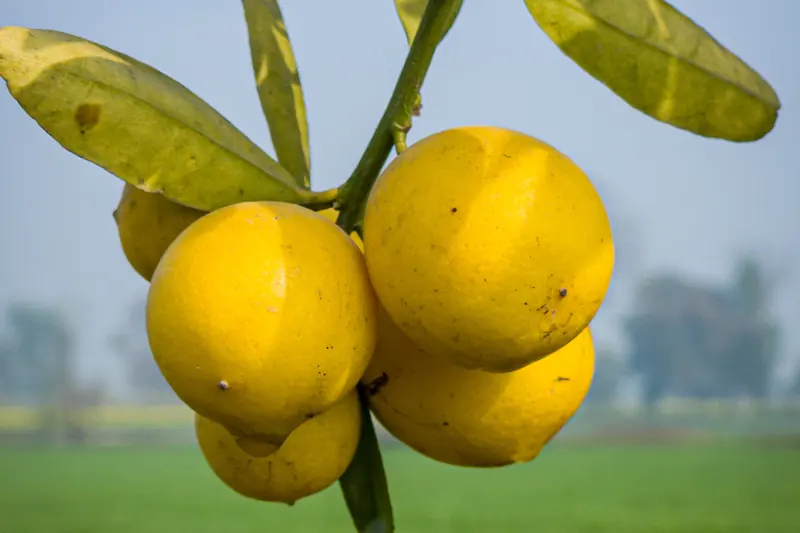
What the sources support for citrus
- Mulch
Escondido's mulch and hydrozoning advice is written for all landscapes, so it applies to citrus as much as avocado.
- Water testing
UC IPM's yearly test of irrigation water is written for avocado growers, but knowing your water's EC and chloride is useful for any tree.
- No softened water
NDSU's caution about watering gardens with softened water covers fruit trees of any kind.
- Salt limits
None were sourced for citrus. The 0.75 dS/m and 100 ppm figures on this page are avocado numbers.
5.3.5 Should you test irrigation water?
Yes, at least once a year. UC IPM's avocado guidance says to test irrigation water quality, and to inspect and test the irrigation system itself, at least annually. The point of the test is to compare your water with the avocado thresholds, so ask the lab to report EC and chloride.
If you water from a private well, the EPA's private well page recommends a yearly test for total coliform bacteria, nitrates, total dissolved solids and pH; adding EC and chloride covers the tree side. County rules on who may collect a well sample for a permit are on our well testing page §7.3. District water customers can read their utility's annual water quality report, which lists total dissolved solids and sodium.
5.3.6 Common questions
- What causes brown leaf tips on a backyard avocado?
UC ANR ties leaf "tip-burn" to chloride the tree takes up from its water. Salt buildup from light watering, saline well water, heavy fertilizing or manure makes it worse.
- Is well water safe for avocado trees in North County?
It depends on the well. UC ANR says many San Diego wells run EC 1.2-1.7, above the 0.75 dS/m level where yield loss begins, so test before relying on it.
- Can a citrus tree share a valve with an avocado?
The sources read give no citrus-specific watering figures. Escondido's hydrozoning advice is to group plants with similar water needs, so judge by how each tree responds.
- How far from the trunk should mulch stop?
Six inches, according to UC Master Gardeners in San Luis Obispo County, who also recommend a coarse mulch.
- How often should avocado irrigation water be tested?
At least once a year, per UC IPM. Ask for EC and chloride so you can compare with UC ANR's limits.
- Does leaching waste water?
It uses about 10% more per irrigation by UC ANR's rule of thumb. That extra is what keeps salt from piling up in the root zone of a salt-sensitive tree.
5.3.7 Sources for this section
Built on UC ANR's avocado irrigation paper and salinity presentation, the UC Master Gardeners of San Luis Obispo County, UC IPM's avocado irrigation page, Escondido's water conservation page, NDSU Extension's softening bulletin and EPA's private well page, all read October 2026. Citrus salt tolerance was not researched, and no San Diego Master Gardener guidance was found. No nursery or contractor sites, and no trials of our own.
Checked October 29, 2026. Inline links in the text above go to each source.