§7.3 Chapter 7 · Drought, wildfire and wells
Well Water Testing
Summary. Well water testing in San Diego County starts with the County's bacteria and nitrate tests, taken by a qualified sampler and run by a certified lab, then continues with EPA's yearly checks for coliform, nitrate, dissolved solids and pH.
Section 7.3 · revised · checked against district reports, code and agency pages · about 7 min to read
Supplier note: this section links to PlumbingSupplyAndMore and SoftPro Water Systems, owned by the people who run North County Water & Pipes. Those links are labeled examples; no figure here depends on them. About these links
7.3.1 What does the County require for a well?
A permit for the well itself and passing water tests before a house or septic system is approved. The County Department of Environmental Health and Quality (DEHQ) requires a permit to build, modify, deepen or destroy a well, and its well FAQ says only California-licensed C-57 well drilling contractors may apply. Drilling and well construction are licensed work.
Before the County issues a building or septic permit, the owner or applicant must show bacteria and nitrate results that prove the supply is potable. Without passing results the County will not grant occupancy. New wells with nitrate above 10 mg/L as nitrogen are not approved, and DEHQ currently allows no nitrate-removal systems on private wells.
The County's role mostly ends there. DEHQ says it does not limit how much a private well pumps, and its well program page notes that wells are often the only drinking water source in rural parts of the County. No County rule for retesting an existing well was found; the yearly advice comes from EPA.
7.3.2 What should you test every year?
Total coliform bacteria, nitrate, total dissolved solids (TDS) and pH. That is EPA's list for every private well, every year, in its private well guidance. Results from San Diego County wells suggest adding a few more items at least once.
| Test | Why it is on the list | Limit or note | Source |
|---|---|---|---|
| Total coliform bacteria | Most common primary-limit exceedance in the San Diego study (36 wells) | Required by the County at the permit stage | EPA; State Water Board GAMA |
| Nitrate | Over the limit in 25 wells in the study | 10 mg/L as nitrogen | County DEHQ; EPA |
| Total dissolved solids and pH | Part of EPA's yearly list | Also useful for irrigation decisions | EPA |
| Uranium and gross alpha | Over the limit in 16 and 19 of 54 wells tested | Uranium 30 µg/L; gross alpha 15 pCi/L | EPA; GAMA |
| Manganese | 33% of wells over the secondary standard | Secondary (taste and staining) standard | GAMA |
| Arsenic and fluoride | Exceeded in some wells in the study | Arsenic 0.010 mg/L; fluoride 4.0 mg/L | EPA |
The federal limits in that table come from EPA's National Primary Drinking Water Regulations. California's own limits for fluoride and uranium were not checked for this page.
Wells that also irrigate trees need one more look. UC ANR notes that many San Diego wells run an EC of 1.2-1.7, and avocado is the tree crop most sensitive to salt; the avocado and citrus §5.3 page covers that side.
7.3.3 What turns up in San Diego County wells?
Bacteria first, then nitrate and natural radioactivity. The State Water Board's GAMA program sampled about 137 domestic wells in San Diego County in 2008-09. According to its domestic well summary, 33% exceeded the secondary standard for manganese, and 35% of the 54 wells tested for radionuclides were above the gross alpha level.
The full San Diego report lists total coliform as the most common primary-limit exceedance, in 36 wells. Nitrate was above the limit in 25 wells, gross alpha in 19 and uranium in 16 of the 54 tested for them, and some wells exceeded for arsenic or fluoride. The study is a snapshot from 2008-09, not a forecast for any one well, but it shows why a single passing bacteria test does not cover everything.
| Figure | What it is | Source |
|---|---|---|
| 137 wells | Domestic wells in the GAMA San Diego study, 2008-09 | State Water Board |
| 25 wells | Nitrate above the drinking water limit | State Water Board GAMA report |
| 16 of 54 | Wells above the uranium limit among those tested | State Water Board GAMA report |
| 33% | Wells over the manganese secondary standard | State Water Board |
| 10 mg/L | County and EPA nitrate limit, as nitrogen | County DEHQ well sampling rules; EPA private well guidance; State Water Board GAMA San Diego report |
| 1 year | How long a County-accepted lab result stays valid | County DEHQ well sampling rules; EPA private well guidance; State Water Board GAMA San Diego report |
| 4 tests | EPA's yearly list: coliform, nitrate, TDS, pH | County DEHQ well sampling rules; EPA private well guidance; State Water Board GAMA San Diego report |
7.3.4 Who can take the sample?
For any test the County will accept, a qualified person, never the homeowner. DEHQ's sampling rules state that "well owners, homeowners, and well drillers may not collect" samples for a potability finding. The sample goes to a lab certified under the state's ELAP program, and the result stays valid for one year.
The SoftPro well water test kit (SoftPro Water Systems, owned by the people who run North County Water & Pipes) is a kit sold for screening well water; it does not replace the County's lab test of a sample taken by a qualified person. A report from a certified lab is what the County, a buyer or a lender will ask to see.
If the well runs dry rather than dirty, report it through the state's Dry Well Reporting System at MyDryWell.water.ca.gov, which a DWR handout posted by the County describes.
7.3.5 Why does a well mean a backflow device?
Because well water of unknown quality could flow back into the public main. The State Water Board's cross-connection handbook lists sites with an auxiliary water supply, which includes wells, among premises that need protection, and every North County district checked applies it at the meter:
- Fallbrook PUD requires a device on any property with a well, then tests it yearly and bills a monthly fee (FPUD).
- Vista Irrigation District requires an approved device on properties with wells.
- Valley Center MWD requires at least a double check on any service with a private well, and an RP where fertilizer or chemicals could enter.
- Escondido requires a device where there is a well and has the owner hire a certified tester each year.
- Rainbow Water names well water of unknown quality as a hazard its program guards against.
Testing and repairing the device at the meter is work for a certified tester or technician under your district's rules. If you're unsure, check with your district or a certified backflow tester. Who tests which device is laid out on backflow testing §5.1.
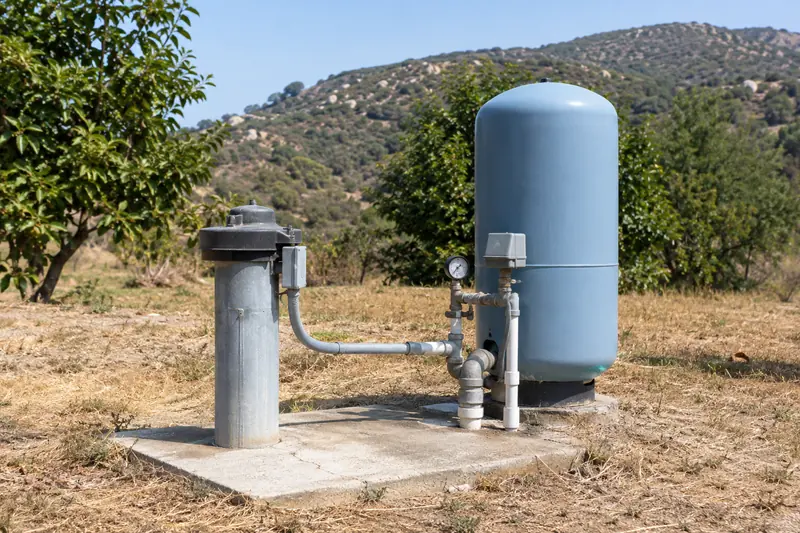
The well's own pressure tank is a separate part of the system; PlumbingSupplyAndMore lists well tanks (PlumbingSupplyAndMore, owned by the people who run North County Water & Pipes) for reference, and pump and tank work belongs with a licensed contractor.
7.3.6 Common questions
- Can I take my own well sample for a County permit?
No. DEHQ says owners, homeowners and well drillers may not collect samples used to decide whether the water is potable. A qualified person collects it and an ELAP-certified lab tests it.
- Is there a filter the County accepts for high nitrate?
No. DEHQ states that no nitrate-removal systems are currently allowed on private water supply wells, and new wells above 10 mg/L as nitrogen are not approved.
- How long is a passing well test good for?
The County treats results as valid for one year from testing. After that, a new sample is needed for a permit.
- Does the County limit how much my well pumps?
No. DEHQ's well FAQ says it cannot limit the amount of water drawn from a private well, and it does not monitor private well levels.
- Should I test for uranium if my neighbors' wells are fine?
Results in the San Diego study varied from well to well: 16 of the 54 wells tested for uranium were above the federal limit of 30 µg/L, so a one-time test is a reasonable addition.
- Where do I report a well that has gone dry?
Use the state's Dry Well Reporting System at MyDryWell.water.ca.gov. It is an online form available in English and Spanish.
- Does a well-only parcel with no district meter need a backflow device?
The district rules read for this page are about properties that have both a well and a district water service. If your parcel has no district connection at all, ask the County's well program what applies.
7.3.7 Sources for this section
The well guidance here comes from County DEHQ's well FAQ, well program page and sampling rules, EPA's private well guidance and drinking water limits, the State Water Board's GAMA San Diego domestic well study, the cross-connection handbook and district backflow pages from FPUD, VID, VCMWD, Escondido and Rainbow, all read October 2026. No well water was sampled for this page, and lab prices and kit comparisons are left out.
Checked October 29, 2026. Inline links in the text above go to each source.